
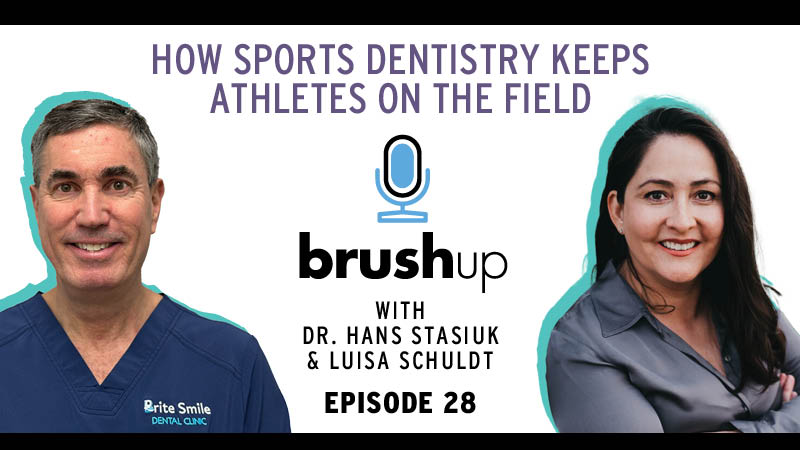
Dr. Hans Stasiuk, a sports dentistry expert, discusses the importance of prevention in sports dentistry and the role of custom mouthguards. He encourages other dentists to get involved in sports dentistry with recommendations on how to do so.


Read the audio transcript below:
Dr. Luisa Schuldt (LS): Hi everyone and welcome to Brush Up, presented by Oral Health Group, the dental podcast where we chat with industry experts about everything from technology and finance to practice management. I’m your host, Dr. Luisa Schuldt, a periodontist and prosthodontist based in Fonthill, Ontario. In this episode, we are joined by Dr. Hans Stasiuk to discuss sports dentistry.
Dr. Stasiuk obtained his Doctor in Dental Medicine Degree from the University of Manitoba in 1995. He has a special interest in sports dentistry, which began in dental school. Since joining the Academy of Sports Dentistry in 1996, Dr. Stasiuk has held numerous roles with the ASD, including President in two occasions, Secretary, Editor and Symposium Chair. He was awarded a fellowship with the ASD in 2006. He has jointly published papers with members of the European Association for Sports Dentistry and the International Association for Dental Trauma. He was co-Mayor and dentist at the 1999 Pan Am Games and volunteered as a dentist for the 2002 North American Indigenous Games. He is currently the team dentist for the Portage Terriers Junior A Hockey Club. Dr. Stasiuk has taught Sports Dentistry and conducted a Custom Mouth Guard workshop at the University of Manitoba for over 25 years. Welcome Hans. Thank you for joining us today.
Dr. Hans Stasiuk (HS): Well, thank you so much for inviting me on, Luisa.
LS: Well, thank you for being here again. And I’d love to hear a little bit more about what sports dentistry is. First thing that comes to mind is trauma. But I know that it is so much more than that. What is it and why is it so important?
HS: Well, first of all, trauma is what seems to sell newspapers as they say. As you know, being a specialist in dentistry, prevention is what’s key. And so the Academy for Sports Dentistry, their main goal is prevention, and if, for some unknown reason, the athlete doesn’t adhere to what our recommendations are, or if an accident still does happen to occur, then we then we go into the treatment mode. So, it’s…we all see all the numerous dental accidents on TV and on the internet, and we hate to see that. We don’t want to see that old, what used to be called the old hockey smile from the 60s and 70s. That’s old news. Now we want the new hockey smile to be what your smile, my smiles look like, Luisa.
LS: Of course. Your interest in sports dentistry started very early in your dental career. Are you an athlete yourself? Or what is it that prompted this, this interest? I
HS: I think that would be a bit of an irony to say that I’m an athlete. I did play sports, but not at a very high level. I wasn’t very good at it. My dad was a dentist, and he never encouraged me to wear a mouth guard, because he didn’t know much about mouth guards either. They’ve always been around for a long time, they really weren’t taught by too many people. And when I was in dental school, I had to do some term papers in community oral health. And so, I thought, what better way than to do something I’m interested in, sports and dentistry. So, I did a Medline search, sort of before internet was around, and I found out about the Academy for Sports Dentistry. Found some articles, and I end up writing two papers. One year was on the overview of sports dentistry, and then the next year I did one on custom fabricated mouth guards.
LS: Well, it’s clearly had a big impact on your dental career to be teaching now how to make the mouth guards, and just how important these are. I mean, it’s something you’ve really dedicated a good portion of your dental career to. How does sports dentistry affect the athlete’s performance, their overall health? I’m sure it’s tied to their well-being in deeper ways than some of us can imagine.
HS: As you know, many people don’t really fully respect their mouth and keeping their mouth healthy. I’m sure you’ve seen a lot of unhealthy mouths too, and how it can affect your overall health. Can cause pain and discomfort, and inflammation. There’s a psychological impact, nutrition issues, as well as increased risk of injury, and then trauma and injuries. And just to expand on those, if someone’s not looking after their teeth and they have a problem, such as an impacted wisdom tooth, they can end up going on antibiotics that may not help. They may have to be hospitalized, go on IV antibiotics and missing several days to weeks of their sporting event. And there was a player from another country playing for the Toronto Maple Leafs several years ago, and he ended up missing a month of hockey due to an impacted wisdom tooth. And he was hospitalized. And you hate to see that. My son was playing football at university, and he ended up having wisdom teeth troubles. And he actually had to have them extracted. He missed about 10 days of practice. So, prevention is important. And I was quite embarrassed when this happened, but just due to his schedule, we weren’t able to get them out sooner, so we sort of had them out in an emergency basis, and then had to sort of suffer the consequences afterwards. But it’s been two years, and he’s been pain free ever since. So it’s just really, really important for athletes to have their teeth checked and to maintain proper oral hygiene and to sort of adhere to what our recommendations are. There’s a lot of things that we’d say that they should do or shouldn’t do to make sure they have great teeth. Also, I mentioned psychological impact. If someone’s missing practices, then they may not get to play that next week, and that’s going to affect them. And if this is a university student now, that might start affecting their study habits and their grades, might affect other aspects of their life. So people don’t truly think of the psychological aspect.
HS: Like, to tell you a story. A friend of mine who’s a team dentist for the Fresno State Bulldogs athletes. Several years ago, he gets a phone call from the athletic trainer who happened to be a patient of his. And he said, you know, we’ve got this player who’s got a sore mouth. Would you take a look at him? So he said, yeah, have him come to my office. So, he took a look at him. Had an impacted wisdom tooth, and it was also decayed. So, he ended up having to miss several days of practice and a game. And he happened to be their star running back. So, guess what? Coach wasn’t too happy. So the coach asked the athletic trainer, what could we have done to have prevented this from happening? The athletic trainer says, I’m really not sure. So he asked my colleague, Dr. Guterres, and he said, well, you know what, if you want, I’ll help look after your players, and we’ll do a pre-season and post-season exams so we can identify problems ahead of time. And of course, if a pre-season exam is done during training camp or very close to start of the season, and there’s a minor issue that can be looked after, but if it’s a major issue, such as take out a wisdom tooth. So there are a lot of ways to help prevent dental injuries, and one of the most important is for athletes to have a pre-season exam and a post-season exam done by a dentist. Preferably someone that’s a member of Academy for Sports Dentistry, so they can be more adept, maybe, and more experienced at identifying potential problems. And one example we use, if someone has a decayed tooth or an impacted wisdom tooth, it’s so important to get that looked after before the season starts. And if you wait until training camp to do your pre-season exams, and you identify a major issue, sometimes the person might still end up missing several days of practice and even have to go be hospitalized if that wisdom tooth is impacted and they have to go on IV antibiotics. So it is so important when the season is over that they either see the team dentist to have an exam done, or go back to the regular dentist, wherever they live, and get an exam done. And if there’s work that’s recommended to have it done, because in university, you’re going to be missing classes, maybe even exams, plus practice time. And some university students are hoping to go on to play in the pros, so that’s going to affect them. If you’re professional, you’re getting paid a lot of money, and the owner of the team and the coach is not to be happy if you’re missing practicing games. And it could have been prevented by dental prevention.
LS: So, it sounds like prevention and earlier convenient intervention are really important. Then we all talk to patients all the time about scheduling any kind of, you know, dental surgical procedure as far away from, you know, your best friend’s wedding or exams or any other events. So, sporting would be just very similar in that way. They don’t want to do it close to a tournament, they have to take into account training. Off-season might be great, and making sure it doesn’t affect their most important opportunities to either train or participate in sports is really, really important. As far as dental injuries though, prevention there is also of super high value for any athlete. What can they do to prevent those sport related injuries?
HS: Well, it goes beyond just facial protection, and know that making sure that you maintain proper hydration. Really the only drink you need is water. Should not be drinking those sugary, acid-filled drinks or energy drinks. Those are bad for your teeth. They’re bad for your overall health. And the only athletes that maybe really need to have some of those, not the energy drinks, but the the other sports drinks, would be high level athletes, such as the athletes that were playing in double overtime in the Jets game last night. So, if you can see my Jets jersey, there you go, because they were actually interviewing one of the Jets players after the game and asked him about his nutrition, you know? And, you know, what do people do to stay hydrated? And food wise, right? And electrolytes are so important. The problem is that citric acid and sugar that’s in most of those drinks aren’t good for you. One of the best ones, too, apart from water, is coconut water, well, as long as there’s been no added sugar to it. So, nutrition is important. Not wearing any oral piercings, or any piercings at all. Making sure that you stay away from using spit tobacco, chewing tobacco, don’t vape, and protecting your teeth by going to see your dentist and having a scan of your teeth made, or if your dentist doesn’t have a scanner, having impressions made. And having a custom mouth guard made.
HS: The custom mouth guard are the best ones you can have. They fit perfectly to your teeth, and they help prevent dental injuries. They help prevent alveolar bone fractures, issues to your gingiva. There’s some evidence that they may help prevent concussions. Speaking of custom mouth guards, I was talking to a friend of mine a couple of days ago who’s a dentist for a professional hockey team in the NHL, who happens to be in the playoffs right now, not the Jets, but another team in the States. And he was saying that he charges a few hundred dollars to his players for the custom mouth guards he makes. We don’t charge that much. That’s what he charges. Anyways, his grandson was playing hockey. I think he was only 11 or 12, and so he told all the parents of the team last year he would make custom mouth guards at no charge for anybody that played on the team. So, he did that. Now this year, his son’s on a different team. So, a mom from the previous team came to him recently and said, can I get a mouth guard made for my son? And he said, yes, it’ll be $380. And she said, because she thought it’d be free. And he said, no, that was only if you played with my son. So she said, okay, well, we’ll do that. So makes appointment, comes in, the boy gets his teeth scanned on the Monday afternoon, and then they want to have her prepaid before she left the office and she went up to pay, and they said it’ll be $380. Ahe goes, oh, I thought it was only $38. She goes, I can’t afford $380 for a mouth guard. She goes, I have to buy hockey sticks. And she’s said, $200 hockey sticks, I have to buy other equipment. So she didn’t care about the teeth so much. So, she goes to Dick’s Sporting Goods on Monday afternoon, after they left the office, buys a store-bought mouth guard off the shelf, gave it to the son. They warmed it up and water fitted it. And son didn’t like it. It was too bulky. So she goes back to store, buys a second one. They do the same thing, warm it up. He tries it in. Didn’t like that one either. It was affecting his speech. It was on his pallet. Believe it or not, they went back and bought a third one. Still on the Monday. The boy still didn’t like it. So guess what? Tuesday morning, mom comes in, pays $380 and says, we want the custom mouth guard. So, point of my story is the ones you buy in the store are not good at all.
LS: So you actually make a really, really great point. And I think if you have any other advice for our listening dentists, or sometimes dental hygienists as well, who are taking impressions and making these for their patients or clients, that story alone is a great way to convince somebody just of the difference in comfort and the value of a custom mouth guard. Is there anything else you think our audience should know about, you know, the quality or the level of protection that they can have with a custom mouth guard versus that store-bought moldable mouth guard. I’m sure there are additional advantages.
HS: Well, I just want to add Luisa, is that my friend also told the mom that if they become patients of his office, that he will give them a credit of $380 towards future dental work.
LS: Oh, that’s so kind of him.
HS: Well, yeah, when I’m making custom mouth guards, I make them in-house so there’s no extra lab fees, and I’ll charge $75. But if it’s a patient of record, I don’t charge anything for them. That’s professional courtesy. You know, a way of me giving back to the patient. And it’s also a bit of insurance for me that if I’m just resting on a Saturday night at nine or ten o’clock at night, it reduces the chance to be getting a phone call from the athletic trainer or a parent saying, oh, one of our players just got hurt. Can you go down the office and see them? And of course I would, but if you don’t have to, you don’t. So, when you talk about the different types of mouth guards, so the ones you buy in the store are extremely bulky. Even if they’re sort of fitted by warming them up, some may still have to bite hard on them. Why? To keep them in place. Because they don’t want them to move around. Very difficult to speak with them in and you’ll see a lot of athletes, in particular, NHL players, chewing on them. And nothing irritates me more when I’m watching a hockey game than seeing these professional athletes chewing on their mouth guards, because they will provide, of course, zero protection. And the young kids are watching it and watching their heroes play hockey, and they’re like, oh, well, if this particular player isn’t keeping his mouth guard in his mouth, he’s just chewing on it, I guess I’m going to do the same thing. And then the problem is that officials don’t always enforce the rules either.
HS: So I want to give a real story that the difference between the custom mouth guards and the ones that are bought in the store. So, Adam Bighill, who played in the CFL for many years. He grew up in eastern Washington, played division three football, and he was born of cleft lip and cleft palate. He had about five surgeries up until about the age of 15, and so he really valued his teeth and protected them, and he started playing football, and he made it to university. And in university, they just gave them the typical mouth formed or boiled white mouth guards, and he hated them. His first year of professional football was the BC Lions, and my good friend Dr. Greg Chang, who’s a team dentist of the BC Lions, made him a custom-fitted mouth guard, and he raves about it. Just loves it, because Adam was a leader on defense, and he’s the one calling the plays, and so he’d keep his mouth guarded all the time. A few years later, Adam signed with the Winnipeg Blue Bombers. That’s when I got to know him. I’ve had him speak before to dentists in Winnipeg, and to this day, he raves about the custom mouth guards that Dr. Chang, Greg Chang, made for him. And so, there’s an example of somebody who’s a professional athlete of a very high level who thinks that the custom mouth guards are the only way to go.
LS: I’m sure for growing kids too, it’s something that has to be taken into consideration. And making them at home, they have no idea when it stops fitting. But if it’s a custom one, they have a dental professional that might be giving them some guidance regarding teeth that are erupting, teeth that our patients are undergoing orthodontic therapy at the same time they’re playing sports. And there are certain provisions that need to be made for those patients. So having a professional involved can be invaluable.
HS: Well, we also recommend…a lot of people have these concerns if it’s someone that’s in mixed dentition or, as you said, going undergoing orthodontic treatment, I would just use a boil and bite one, because the teeth are constantly moving. And you know, anybody that knows anything about orthodontics, you have a general idea of which direction the teeth are going to move. So you can block out some space on the model and then make the mouth guard, and then maybe every three or four months you made a new mouth guard. And the actual cost of a mouth guard to make isn’t that much, but it’s a value that you get from protection.
LS: Of course. What are some of the innovations with regard to mouth guards, new materials or many ways of making them?
HS: Well, Luisa, that’s a great question. I’m really glad that you asked it. So, years ago, the first mouth guard that was ever worn was in the late 1800s and then it was just a piece of gutta-percha that was sort of placed over top of the maxillary anterior teeth. And then there was a boxer in 1913 in England named Kid Ted Lewis, and his athletic trainer had made some form of mouth guard of some type of rubber for him, and he wore that. Well, the opposing athletic trainer said, oh, he has an unfair advantage. He shouldn’t be wearing that mouth guard. And, of course, we all know the reasons why it was for protection. Fast forward many years, we had the vacuum form mouth guards, which were okay, but they didn’t stay in place that well. And then several companies came out with pressure laminated machines to make the best custom fitted mouth guards. And there are the Erkodent that’s sold in North America by Glidewell. There’s Drufomat that’s made by Dreve A. And then there’s the Biostar, which is carried by Great Lakes Orthodontics in the States. And so those three machines are similar but different, but you can make the best mouth guards. Athletes love them because they’re not too thick, they can speak with them, they can breathe, they don’t have a bad taste.
HS: Yes, they might try and still chew on them, but they’re not going to break down nearly as quickly. So that’s sort of where we’ve been until recently. Now there’s some new innovations. There are 3D-printed mouth guards. That technology is still evolving, because we find that the material is a little bit too hard, it’s not as comfortable as it should be. So, just because it fits well, if it’s hard and uncomfortable, athletes likely are not going to wear it, so they’re still working on that technology. Then there are smart mouth guards that have sensors in them.
LS: Wow.
HS: And there are a of couple companies that make these custom mouth guards. I was just down last week in Irvine, California, Glidewell labs for a symposium on technology. And I had the pleasure of spending about an hour doing one-on-one session in the lab, learning all about the ORB Smart Mouth Guard, which was designed in United Kingdom, but it’s now being fabricated at the lab in Glidewell, California. And there’s a sensor in there that hooks up to an app on your phone. It can tell you when you might have some concussion symptoms. It can measure heart rate. There are just some, a whole list of different items that you can get and benefits from wearing one of these smart mouth guards. And the last type. So, the third type. So, you’ve got 3D, we got smart. Are the bite correcting appliances or a mandibular advancement mouth guards, which usually involves some neuromuscular dentistry, and where you’ve got a tension that’s placed on your face, on your shoulders, for about 45 minutes. It relaxes all your muscles, and then you’re able to make a new bike registration with your mandible in a relaxed forward position. From there, you make a special mouth guard. It’ll protect your teeth, it can improve your performance. If you are a golfer, and wearing one, you might be able to drive the ball a few extra yards. If you are a puncher in football, maybe you can put the ball an extra couple yards. But we do not call them performance enhancing mouth guards, because one, if the World Anti Doping Association says if you have anything mechanical on your body or in your body that improves performance, you can’t use it. So, it would be a shame if people start calling them performance enhancing mouth guards, because wouldn’t know the difference between a custom regular, custom fabricated mouth guard or all these bite correcting appliances. And guess what? It could ban mouth guards altogether. So we really need to say, please don’t call it performance enhancing even though it might help.
HS: And so, my good friend Walter Chitwood, Dr. Chitwood, who’s from Nashville, Tennessee, he works with the Middle Tennessee University athletes. He works with the women’s basketball team, men’s football team, and some of the other sports and so he does this balance test with the athletes. So basically they stand on one leg, stick the arm out, and he presses the arm down to see if how they can maintain their balance. And they usually fall over. He then puts the MAM appliance, or the bite correcting mouth guard he made, in their mouth and goes through the same routine, and they do not fall over. And I’ve seen videos he shared with me showing these athletes, and they rave about them. And one of the athletes, actually, Reed Blankenship, played in the Super Bowl for Philadelphia Eagles this last year. He was wearing one of those mouth guards.
LS: And one last question for you. Hans, how can dentists interested in sports dentistry get more involved? Could the Academy for Sports Dentistry potentially be an opportunity for them, or what recommendations would you have?
HS: Well, first of all, a lot of people think that if you’re not a team dentist, why would you be having any interest in sports dentistry? But every dentist is a sports dentist. They just don’t realize it, because you never know when a patient’s going to come in, or even someone that you’ve never met before, and the mom or dad phones and says, you know, my child fell off the swing set at school or fell off their bike and they have an injury. Can you look after them? So, you always want to be prepared for treatment at any time. So we say everyone’s a sports dentist. The Academy for Sports Dentistry was founded in 1983 in San Antonio, Texas, and it’s a group of dentists, athletic trainers and dental assistants and hygienists, that are just interested in preventing dental injuries. We encourage any dentist that wants to join, or hygienist, assistant, to join the Academy. The membership dues are only $210 US per year. We have a symposium once a year. One of the best things about the symposium is, in addition to the lectures, is all the networking, and you learn from each other. I always say, you know what? Yes, you learn a lot during the day and get your CE points, but sometimes you can learn just as much, even more, over a beer in the lounge in the hotel lobby, right? And so I and the ASD also have a sports team dentist course that we offer during a symposium. There are about 10 to 12 hours of online didactic classes you take ahead of time. And then there are the workshops. There’s a splinting workshop, suturing workshop, and also custom fabricated mouth guard workshop. If you happen to be in the States and you want to help out with the Olympic athletes, you have to be a member of ASD and have taken that course within three years of helping out. In Canada, for the first time at the Pacific Dental Conference in 2026, a group of six ASD members are planning on teaching a sports team dentist course. So, I encourage dentists from any place around the world, but particularly Canadian dentists who are going to be watching this podcast, to come to Vancouver in 2026 and take the course. You will get probably about 16 hours of CE points, including all the pre-work online. And it’s a wonderful course. You will get a lot of knowledge, even if you don’t work with teams, just treating patients in your office, it’s still a good service to your patients and yourself to have this background.
LS: Of course, it’s a great opportunity for a practice builder as well. If the teams, youth teams in your area, know that you’re prepared to manage these situations, you would be their go-to person, right?
HS: Well, exactly, sorry. No, you’re exactly right. And you know, you go to the symposium, or even a different sports dentistry lecture, and hopefully when you leave there, you’re prepared on Monday morning to handle emergencies. You just never know when that next emergency is going to come into your office.
LS: Thank you so much, Hans, that was a really great conversation. Thank you to our audience as well for listening. Be sure to sign up for Brush Up Podcast alerts and subscribe on Spotify and YouTube to be notified every time we post a new episode. We’re going to have additional episodes on sports dentistry so please join in for those. And please keep brushing up!