
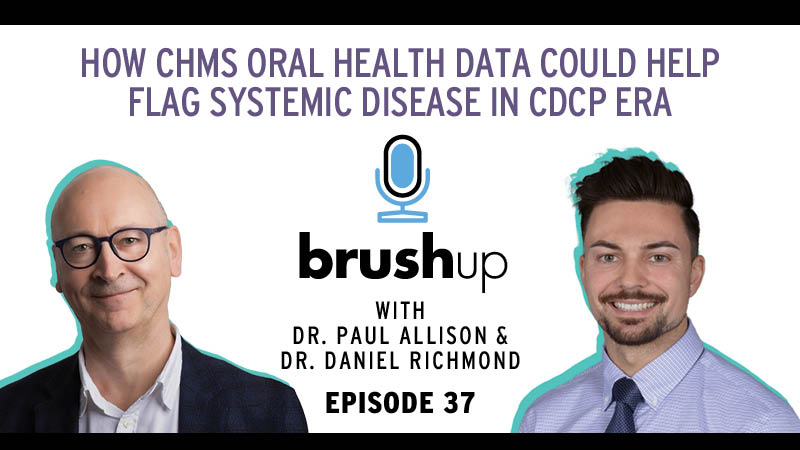
New findings from the Canadian Health Measures Survey (CHMS) reveal a surprising trend: Canadians are losing fewer teeth but gum disease is getting worse. Dr. Paul Allison, Professor at McGill University, unpacks what the data really means, why oral health may signal broader inflammatory disease, and how dentists could help screen for chronic conditions. He also explores bold public health ideas and what it will take to truly connect oral health with overall health.
Read the audio transcript below:
Dr. Daniel Richmond:
Hi everyone and welcome to Brush Up, presented by Oral Health Group. I’m Dr. Daniel Richmond, an orthodontist based in London, Ontario. In December, Statistics Canada released new oral health findings from the Canadian Health Measures Survey (CHMS). The first direct measure national data in more than fifteen years. The results show a mixed picture. Canadians are keeping more natural teeth, but caries levels have not improved and periodontal indicators have worsened.
To help us interpret what this means for clinical practice, population health and future policy, we’re joined by Dr. Paul Allison, professor at McGill University’s Faculty of Dental Medicine and Oral Health Sciences. Dr. Allison led the national research team that secured funding and developed their proposal for the CHMS oral health cycle. He is also a fellow of the Canadian Academy of Health Sciences, a recipient of the Queen Elizabeth the second Diamond Jubilee Medal, and a member of the Lancet Commission on Global Oral Health. Dr. Allison, welcome to Brush Up.
Dr. Paul Allison:
Thanks, Daniel. It’s a pleasure to be here.
Dr. Daniel Richmond:
The new Canadian Health Measure Survey results show declining tooth loss, unchanged caries levels, and worsening periodontal indicators. What does this combination of stability and deterioration tell us about the overall state of oral disease in Canada?
Dr. Paul Allison:
So first of all, I think it’s important to state that the report that was released, last week, by Statistics Canada was the very first report on this survey. It’s got fairly minimal data in it, so it’s very difficult to understand. It’s just a preliminary overview of their findings, so we have to be very careful in trying to understand happening and wait until more detailed data are released so the researchers can analyze those data. And also, I’m sure there’ll be more detailed reports emerging from Statistics Canada over the coming months.
That said, I’m not at all surprised by the fact that there’s been a fall in rates of tooth loss or amounts of tooth loss in the population. The trends in Canada and elsewhere in the world have been declining over the last decade, so that’s entirely what we would have expected. More people want to keep their teeth as much as is possible, and we have more means of doing that to help people. So, I think that’s entirely predictable.
The caries rate stagnation, unfortunately, is somewhat predictable as well. I mean, we saw a big decline through the eighties and nineties and maybe into the early noughties. But since then, globally, there’s been very little change. And this is because there’s lots of people still eating lots of free sugars, and that’s the main cause of caries.
In terms of gum disease, I think we need to be very careful. Gum disease is a very complex series of conditions, and it’s very difficult to measure. So, we have to again understand precisely what they mean. For instance, they talk about increase, they mentioned a decrease in two millimeters pockets and an increase in three millimeter pockets. Well, when I hear that, I’m saying to myself, well, what’s a two-millimeter pocket? Do they really mean a pocket? Or do they mean loss of attachment? Etcetera. So, if it’s just a pocket, in other words the sulcus and there’s two or three millimeters, that’s healthy, that’s normal. There’s nothing wrong with that. I only get interested when we talk about loss of attachment of four or five millimeters.
And then you have to ask yourself when they talk about that, is that one site in the mouth or is it several sites in the mouth? Because as I’m sure we’ll all agree, if you’ve got one site in the mouth with loss of attachment of two or three millimeters, and you’re a forty-year-old or fifty-year-old or whatever, an adult, frankly speaking, that’s not a big deal. If you’ve got lots of them, on the other hand, that is a big deal. So, I think, all that to say that, these are preliminary reports. We have to find out the more detailed information.
Dr. Daniel Richmond:
So, there’s a lot to unpack still. And so, looking more at the periodontal indicators, they’ve worsened. Do you think that this suggests anything about broader inflammatory or immune related patterns in the population?
Dr. Paul Allison:
First of all, I’ll make it very clear to all your watchers and the audience that I’m not an expert in gum disease, and I’m not an expert in the links between oral health and general health. I’m a public health specialist. I have a broad interest in this field because I think it’s very important for us to try and understand it.
I know there’s been a lot of research in the last two or three decades trying to better understand the links between oral health and general health. And in my understanding, the vast majority of research in this field, there are lots of them, they’ve found associations, but that’s what they are. They’re associations. They’re not cause and effect. And the fact that we have not advanced in our understanding of this and been able to demonstrate cause and effect, just lots of different associations, suggests to me that there isn’t perhaps the relatively simple cause and effect link that we all would perhaps like to see just because it’s much easier to understand. That gum disease causes heart disease or diabetes or low birth weight babies or countless other things that we’ve read about and heard about. In my mind, I think we should be stepping back from looking at this cause and effect and trying to understand, okay, this is an association.
What it means is that in my mind, there are things that cause the inflammation of our gums, and therefore a little bit of gum disease, or quite a lot of gum disease. Gum disease may be actually an indicator of what’s going on in the rest of our body. In other words, this low-grade chronic inflammation and gum disease may be an early indicator of things that may subsequently happen later in our lives. We know the data are very strong to show that the peak incidence rate for new incidence of loss of attachment is amongst young adults.
And I was very interested to see that when they talked about gingival inflammation in this Statistics Canada report, they found there was higher rates of gingival inflammation in young adults. So, I’m asking myself, is this gingival inflammation gingivitis? Frankly, I’m not worried. Gingivitis is an acute inflammation that comes and goes in a few days and that’s it. It’s very common. It’s not a big deal. On the other hand, if it’s gingival inflammation, that then becomes gum disease. That’s clearly an issue.
But I’m just wondering if the fact that it’s more common in young adults, is this related to this peak incidence of gum disease there? And is that then making us, I’m thinking, should gum disease in fact be a marker that we can use to say that there’s other chronic low-grade inflammation going on in our bodies, which is much more difficult to detect and understand what’s happening. But there’s lots of research these days showing that low grade chronic inflammation in our bodies is responsible for heart disease, responsible for cancers, can be responsible for diabetes.
So, I’m increasingly thinking we should be thinking about gum disease as a marker of chronic inflammation in our bodies, so almost like a screening tool. The dentist and the dental hygienist, the dental team, can be looking in people’s mouths and saying, okay, you’ve got some gum disease. You’re a thirty-year-old who’s got your first pockets. Do you have family history around heart disease or any cancers? Maybe you need to go and see your GP and do some more in-depth tests. Yes, we’re going to try and help you reduce your gum disease, but recognizing what we can do is fairly limited on that front. But I think in my mind, from a public health perspective, that’s the way we should be thinking in the future.
Again, that’s just my thinking. I think we have to do lots more research to fully understand this, but I do think, we could be thinking of gum disease as a marker and a screening tool, and indeed, when we think about this link, early childhood caries is the same thing. When a two-year-old or three-year-old has dental decay, that means they’re eating lots of sugar. That means that they’re at very high risk for diabetes, obesity, heart disease, when they’re in their adolescence and then young and older adulthood.
So again, the mouth can be a screening tool for young kids and then for caries and then young adults, I think, for gum disease.
Dr. Daniel Richmond:
Yeah. It’s fascinating. I think it reminds me of during our dental training how everyone says the mouth is a window to the rest of the body. So, clues what might be going on in other organs or systems. Yeah. It’s very interesting. So, you have emphasized that most oral systemic research is associative. So how should clinicians interpret oral conditions such as the early childhood caries or periodontal inflammation as markers of shared risk factors rather than direct causes? Like, what’s the next step once you once you see those conditions present in the mouth?
Dr. Paul Allison:
Well, I think, obviously caries, the cause and effect with sugar is very clear. So clearly the caries needs to be addressed, managed, whether that’s with restorations, fluoride therapy, that sort of thing. But also thinking about their diet and the family, because it’s in families, so what can you do about the diet and help people making healthy choices and all that sort of thing. So, I think that we have to treat the condition.
Same thing with gum disease, we have to help people keep their mouths as clean as possible. But recognizing a big part of gum disease is the immune response, and I think there’s very little we can do about the immune response. We have to recognize that it’s up to people to keep their mouths as clean as possible. I think for most people, that’s the most important thing. It’s not going to see a dentist or a dental hygienist every year or however often it is, because the dirt in our mouths is in our mouths on a daily basis. So, it’s up to us to clean our teeth, not up to professionals to do. There are some people with severe gum disease that need that help. So, the point I’m trying to make is we still need to manage the conditions themselves, but what I was trying to say in my earlier response is we also need to think about these are markers of what’s going on in the rest of our life, and they’re socially determined.
Our chronic disease, which is caries and gum disease, are socially determined things. They’re much more common in people coming from poorer groups, more marginalized groups, than they are in those of us who are lucky enough to be relatively wealthy, well educated, etc. So, these are really markers of that sort of social pattern. And we need to be aware of that. And again, I think we need to be talking with the patients and asking them and suggesting to them that maybe they should be going to see their doctor to have discussions around managing the broader health problems that may emerge because they’re consuming too much sugar or because they’ve got an autoimmune response creating the gum disease, which means that they may have other autoimmune diseases in their body that may not have they may not have emerged yet, but they may emerge over the coming years.
Dr. Daniel Richmond:
Okay. Interesting. Yeah. So, a lot of the day-to-day habits are where this all starts. And maybe as dentists, we can educate people on the broader impacts that it might have.
Dr. Paul Allison:
Yeah. I mean, yes, we need to do that, but we need to recognize as well that people’s capacity to change their behavior is very much determined by their environment. It’s very difficult to change behaviours. So to say to somebody, you need to reduce the sugar in your diet, I mean, I think most people can understand that, but to actually do it is much more difficult. Particularly as we eat in families, and there’s so many things that go around what we eat in our families, and then it’s our culture, whether that’s an ethnic culture or whether that’s just a social culture, etc. So changing behaviors are very complicated. And, again, speaking from a public health perspective, we focus very much on trying to create environments which make healthier choices easier.
The obvious example to that, and it works very well, is taxing sugars. There’s lots of evidence from over a hundred countries across the globe that it works well in terms of reducing sugar consumption. So, taxes on the common things is taxes on sugar beverages. You put that on, it reduces consumption. It reduces the amount of these drinks being bought, reduces consumption. It also changes the behavior of the companies because they will change the concentration of sugar in their drinks to fit with the legislation in the country, and so that you can force reduction of sugars there. And there’s been a number of countries that have shown reductions in numbers of kids having to be put to sleep for caries management.
That’s quite common. Big studies in the U.K. showing that. And then a big study in Mexico showing actually reduction in caries rates. And that’s caries. And you think about there’s lots of studies looking at reduction in obesity, there’s lots of studies looking at heart disease. So, we have to go upscale. Yes, as dentists and dental hygienists with the patient, yes, you have to have that conversation, so they understand about sugar, for instance. But us in the world of public health, we have to change the environment as well, help change the environment, and that sort of thing helps.
Dr. Daniel Richmond:
You’re reminding me of something you taught us maybe ten years ago now, but the knowledge, attitude, and behavior is the last step. So, these Canadian Health Measures Survey results, they’ll serve as the baseline for monitoring CDCP impact. Which indicators, such as untreated disease, pain, functional limitation, or even service use, do you see as most informative for tracking its progress?
Dr. Paul Allison:
So, as you said, the Canadian Health Measures Survey just by serendipity was done pretty much at the same time as the CDCP starting out. The survey, the fieldwork was done in a two-year period from the autumn of 2022 to December 2024, which fits very well. So yes, everyone’s been saying this report, all these data are going to serve as a great baseline to see what effect CDCP is. But we need to understand that health is determined by the social environment, as I’ve been saying. It’s determined by what we eat. It’s determined by whether we exercise. It’s determined by whether we’ve got a job, all sorts of social indicators like that.
Health care helps to get rid of disease once you’ve got it, but it doesn’t stop the disease happening in the first place. So, we have to be very careful in understanding that. But if you choose the right indicators, like you indicated in your question, then we can see whether CDCP helps. So, for instance, you mentioned untreated disease. People will get the disease. So, caries is the obvious example. They’ll get caries. But then the big question is can they get that treated?
Before CDCP, the people most marginalized, the poorest parts of the community, were the parts of the community with the highest level of caries, but they couldn’t afford to go and see the dentist, they had no insurance, so they had untreated disease. And what we want to see, what a public health care system does, is it reduces inequalities. It doesn’t reduce the disease, it doesn’t completely get rid of inequalities. They will still exist, but it will help reduce them.
Unfortunately, what private systems do is they increase inequalities because there’s lots of people who can’t afford to use those private services. So, what we really want to see is are the levels of untreated disease being diminished, and particularly are the differences between levels of untreated disease in richer and poorer groups diminishing. That would be really good. And then similar to that, we want to see whether there’s things like pain indicators. Is there less pain in the community? Are people able to chew and eat all the different foods that they want to? So, these are the sorts of indicators that we’re really interested to see, and hopefully over the course of the next few years, and when we get another survey done, we’ll be able to see whether those things have changed and relate them to the CDCP.
Dr. Daniel Richmond:
CHMS findings show persistent disease burden, and the Canadian Oral Health Survey indicates that one in four Canadians avoid dental care due to cost. How should policymakers interpret these findings together and where do you think investments could have the greatest impact?
Dr. Paul Allison:
Well, I mean, this is related to inequalities in society. I mean, Statistics Canada, just this summer was published results showing the very high level of inequalities in Canada. The data, I’m just looking at my other screen here. The data they showed said that the top 20 percent of in terms of wealth of Canada’s population own about 65 percent of Canada’s wealth, whereas the bottom 40 percent own about 3.3 percent of Canada’s wealth. So, there’s very, very big differences. There are other countries, I’m sure we’ve heard about, with even bigger levels of inequality, but there’s a lot of inequality. And those determinants of inequality, they’re very strong determinants of how healthy we are or not.
So, as I said, CDCP is going to start to help, but those social determinants of inequalities will still remain unless governments decide that they want to try and address them. Some governments are, whether we’re talking about provincial governments, federal government, governments in Canada, governments in other parts of the world. Some governments want to address inequalities more than others. So, it’s really up to government policy around trying to deal with inequalities. But I expect we haven’t. The preliminary data that came out of the CHMS last week didn’t talk about the inequalities, but the data are there and can be analyzed. So, I’m hoping that we’ll start to see over the coming months what are the levels of inequality. Frankly, I don’t expect there to be much change compared to the inequalities that were seen in the previous CHMS survey fifteen or sixteen years ago. Hopefully, we’ll start to see some reductions if we go forward and we have another situational survey of oral health in the next five, six, seven years.
Dr. Daniel Richmond:
Very interesting. A recent study linked self reported flossing to lower stroke risk, but you’ve noted concerns about measurements and confounding behaviors. How should clinicians evaluate these association studies and how can they communicate such findings without overstating what flossing can or cannot do?
Dr. Paul Allison:
So, this gets back to what I was saying in the beginning. You know, these association studies, I mean, there are countless studies that exist like this. And my first reaction is to say to them, okay, how did they measure flossing? I mean, think in this particular study, had a quick look at it, and it seemed to be saying, do you floss once a week? Okay? So, it’s a self report behaviour. We are all optimistic, positive, when we respond to those sorts of questions. It’s like asking how much alcohol do you consume? How much exercise do you do? Do you eat too much food? You know, when we respond to those things, it’s self report behaviours.
The tendency is to give what we call socially acceptable responses. So, lots of people will know it’s probably a good idea that they floss their teeth. So, they’re more likely to say, yes, they do, than no, they don’t. But then you ask yourself, flossing your teeth once a week? Is that really going to make any difference or anything? Our teeth get dirty, you know, every time we eat, so flossing once a week, I’m not sure. So, my view is it’s a what we call in epidemiology a “proxy indicator.” In other words, it indicates that people know that it’s a good thing to do potentially, therefore they say they do it, but actually it’s an indicator of knowing stuff, and actually maybe it’s another indicator of other forms of behaviour that are much more related to stroke.
So, it may be an indicator that they’re exercising more, and that’s helpful for stroke, for instance. I have no idea. But I’m very skeptical of there being a direct link of flossing once a week and risk for stroke. Perhaps there is, but I have my doubts.
Dr. Daniel Richmond:
Yeah. No. That makes sense. Six research teams are now funded to conduct in-depth analyses of the CHMS oral health data. From your perspective, what questions should these teams prioritize, especially regarding oral conditions as markers of sugar related issues or chronic inflammation?
Dr. Paul Allison:
Absolutely. So, they’re going to be addressing a broad range of issues, a lot of which is trying to better understand these links between oral health and general health, which is really important. I think there are some other issues as well around trying to understand things like toxicity. That’s become an increasingly important area to look at. So, for instance, lots of the listeners today will be aware that with the Minamata, the goal of the Minamata Convention is to remove mercury from the environment because it’s a very toxic element. They’re not very interested in when they make this agreement, in amalgam per se.
Amalgam, as we know, is incredibly safe and in fact an amazing restorative material. It works really well, but it’s got mercury in it. Therefore, already in Europe, they’re starting to push it out and it’s coming to Canada. Will you know, if we go forward, I don’t know, ten years or so, probably we won’t be able to use it anymore. But then you start to say, okay. Now we have to use more composites, and we maybe have to develop other materials. But now we have to ask ourselves, what about some of the plastics and the other chemicals in composites? Everyone was focusing on the potential toxicity of a mercury in amalgam, and there’s no evidence whatsoever that there’s any toxic effects of mercury in amalgam. It’s completely stable. But there’s been very little research on the toxic effects of composites. The fact that composites don’t work nearly as well as amalgam, that’s another thing in terms of sustainability for the environment. And that’s a big deal. Sustainability of the environment and healthcare is a really, really big thing that’s beginning to emerge. And as we know, dentists use a lot of materials, lot of plastics. So that’s the sort of thing that is beginning to emerge, lots of investment in research in those areas. And those are really, really important terms of contributing to the climate, and sustainability and all that sort of thing.
Dr. Daniel Richmond:
In earlier discussions on integrating oral and general health, you highlighted several needs, placing oral health professionals in a wider range of settings such as hospitals, community health centres, and long-term care homes, training dental and medical providers to collaborate, and moving toward integrated electronic health records. Which of these steps do you see as most realistic to advance in the next few years?
Dr. Paul Allison:
Well, in my career, I’ve always been a pragmatist and a political opportunist. So, I think all of those things that you’ve just mentioned are really important in my opinion. Oral health care, dental care needs to be much better integrated with medical care, and we have to have oral health professionals in hospital settings, community health care settings, long term care settings, all the things you just mentioned. But all of those things require quite a lot of investment. But I would say we’re now at a time where the federal government has invested massively in dental care, and now’s the time to keep pushing. The door is ajar in a way that was never before. I remember if you go back twenty years, I was trying to talk with people and saying there’s big problems in dental care because there’s lots of people who can’t access it. Going back 20-15 years, no one was listening. No one was interested. Now they’re everyone’s listening. They’re interested.
Yes. They’ve got other areas where they’re concentrating on if we think of Canada and the recent budget. Clearly and for reasons we all understand. They’re very concentrated on the economy with all that’s going on in the world at the moment, defense spending, all those sorts of things. But I think we have an opportunity, for instance, if we push the links that I’ve been talking about and that dentists are very aware of, and increasingly physicians are as well, of links between gum disease and health and caries and health, and the associations and the fact that the mouth can be this amazing screening tool, that’s an amazing way to push that angle. Dentistry needs to be much more involved, and you can say, right, we need combined electronic records, and we need more dentists in a clinic right next to the family GP and others, etc. And if we can say, look, this is going to help reduce costs because one of the things that governments across the world everywhere are suffering from is the increasing cost of healthcare, and the fact that more and more older people are living longer and longer with multiple chronic conditions, our systems are beginning to break.
They just can’t cope with the number of people with all these chronic health problems. Now, if dentists are able to say, well, we could actually try and help by screening and managing some of these conditions earlier on, I think that’s where we can go. So, it’s a long answer to say we have to see where the opportunities are and push for all of them in in different ways.
Dr. Daniel Richmond:
Yeah, and use some of this momentum that dentistry has at the moment. So, we’ll get you out here with one last question. Looking ahead, based on the trends emerging from the CHMS and broader research, what do you think will matter most for shaping Canada’s oral health landscape over the next five years?
Dr. Paul Allison:
Well, as I said, our health, including oral health, is determined by social determinants, by commercial determinants. So, it depends on what our governments wants to do in terms of investing in the health of populations. And when I say health, I deliberately say health, not health care, because health care focuses on when people are sick already. It focuses on hospitals and treatment of people who are sick. What we really need to do is start investing much more, as we would say in public health, upstream to try and help stopping these diseases occurring in the future. But that really depends on government priorities, and as I just mentioned in my previous answer, understandably the Canadian governments and many governments across the world, their priorities are on the economy. They need to make sure the economy is working well. They need to start thinking about defense because the whole world situation is changing very rapidly. They need to think about immigration. They need to think about housing. But then once you start thinking about immigration and housing, you start to think about how these touch the social determinants as well as the economic strategies as well.
You need to think about lots of people coming into our country, a country of immigration, both people needing oral health care, but also lots of oral health care providers coming in from elsewhere in the world. As we know now, more and more dentists get a license. There are now in the last few years, more dentists who receive a license every year were trained outside Canada than inside Canada. So that’s another discussion that needs to happen with governments. Governments are now massively investing in dental care, but they also need to massively invest in dental education, in other words, the training of dentists and other oral health care professionals.
We’ve had ten dental schools graduating about five hundred graduates for the last fifty odd years. In the meantime, the population of Canada has more than doubled. So that whole dynamic needs to start changing. They invest massively in training of nurses and physicians. Dental care needs to be invested in somewhat as well.
Dr. Daniel Richmond:
Fascinating stuff. Dr. Allison, thank you so much for your time today. It’s always interesting learning your thoughts and what’s new in the world from a public health point of view. And, to our listeners, thank you so much for tuning in.
Be sure to sign up for Brush Up podcast alerts or subscribe on Spotify and YouTube to be notified every time we post a new episode. Keep brushing up!