
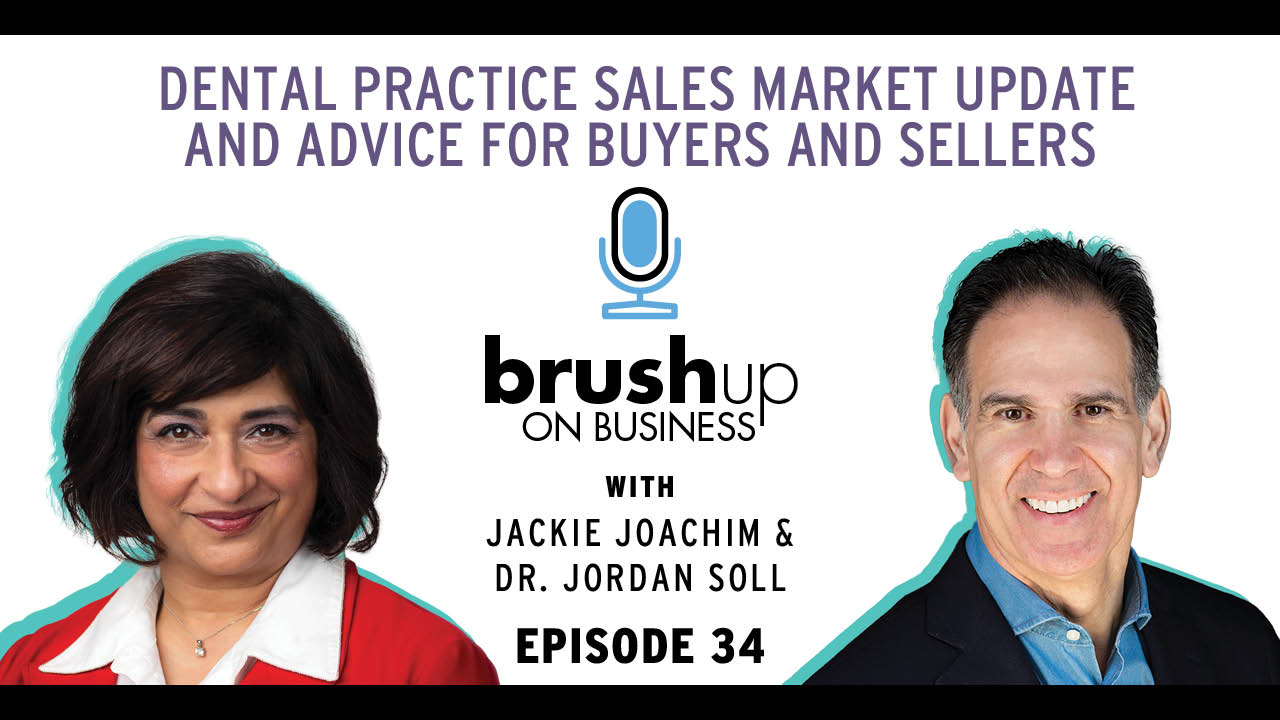
Jackie Joachim, COO of ROI Corporation, and Dr. Soll discuss the current state of the dental practice market, providing insights for any dentists looking to buy or sell a practice in the near future. Jackie also discusses interest rates and how the CDCP may be affecting offers.


Read the audio transcript below:
Dr. Jordan Soll (JS): Hi, everyone. Welcome to Brush Up on Business presented by the Oral Health Group, which is a special Brush Up podcast series focused on the business of dentistry. I’m Dr. Jordan Soll, chairman of the Oral Health Editorial Board and principal of Central Dental Group.
Today, I’m joined by my good friend, Jackie Joachim. Jackie graduated from the University of Toronto with a Bachelor of Arts degree in business and has nearly thirty years of experience in the health care sector. She’s currently the Chief Operating Officer at ROI Corporation, and Jackie has developed and delivered seminars to health care professionals across the country and has coached hundreds of practitioners for planning, marketing, patient education, human resources and financial management. Jackie, welcome and thanks for joining us today.
Jackie Joachim (JJ): Well, thank you for having me here, Dr. Soll.
JS: Jordan.
JJ: Jordan.
JS: Okay, so let’s ask the burning question that everybody wants to know, specifically after we’re just clawing our way out of the pandemic. Are people still purchasing practices?
JJ: They are absolutely purchasing practices. If we sold them during the pandemic, I don’t think there’s anything that’s going to stop it now. For sure, things like interest rates, an unknown CDCP, how it’s actually all going to unfold, have definitely made people think when they’re making an offer, but we’re still having listings and we’re still successfully selling offices. I mean, the end of the day, what is a dentist supposed to do? They have to be in their own business by default, or they work for public health, or they work for someone else. So, if you want to be in control and own your own office, you either start or you buy.
JS: Is the volume the same as pre pandemic of people listing, people buying? Are you seeing the same transaction, same action?
JJ: I would have to say we’re busier.
JS: Wow.
JJ: Yeah. And that that’s something that continues to surprise me as well. And I think that’s for several reasons. For the longest time, our CEO Timothy Brown, would say that, you know, the baby boomers have to start selling, but they were holding. And now people are just getting to an age and stage where it’s finally making sense. So, you’ve got that category that’s ready, truly ready to retire. Then you’ve got the folks that are coming up but don’t want to put down the drill. So, they’d rather sell now and transition after maybe, you know, three, five years, whatever makes sense for them.
You’ve got another group of people that want work life balance, and they’re, you know, between, say, forty, forty five to about fifty, fifty five because they felt like they’ve run their practice, it’s taken a lot out of them, and they want to start enjoying life a bit more. So, they’re again, they’re happy to sell, keep working, and, you know, just have some of that work life balance.
There’s always been a multitude of buyers. You’ve constantly got new graduates. Obviously, a new graduate wouldn’t go on day one and buy a practice or start one off. But you do have, after five, six years, they’re in a position and they’re ready to purchase. You’ve got the international dentists who come from somewhere where they already know how to run an office, but they’re more ready to get into their own because they’ve restarted life. You’ve always got the Canadians that have gone to U.S., Australia, wherever. So, there’s a multitude of purchasers. And then, of course, we can’t leave out the corporates. And by corporates, I’m not necessarily referring to the big guys. I’m also talking about the individual dentists who might own three, five, fifteen, thirty. They’re still corporate. So, there’s a lot of buyers out there.
JS: Okay. Let’s get down to the nitty gritty. What was that in Jerry Maguire? Show me the money. Have practice values declined? Are they up? What’s going on with practice values and valuations today?
JJ: So, values are not down. They have not decreased. A lot of times people thought the interest rate would cause the value to come down. Interest rates, when you look at our methodology for appraising and selling, and even other sources of how they do their appraisals, it’s not the interest rate per se that causes the value to come down. It might affect the offer that is made and accepted because people will factor in debt repayment when they’re making an offer on a practice. And we’ve always said, even long before the pandemic, years and years, I would say it, Tim would say it in his lectures, there’s two values. There’s a value that we place on something as the valuator, but then there’s the market value. And the market value is the really true value. It’s what a buyer and a seller agree upon. So, whenever you see a practice that’s sold for well above its appraised, it doesn’t mean we got it wrong. It just means that particular practice was that valuable to that person.
And same goes the other way. If it’s selling a little bit less or even a couple hundred thousand dollars less, it’s again not saying that we were wrong, it’s just there were reasons that the two parties came to that agreement. So, the one time I think that we thought values might have gone down again would have been during the pandemic. Logically and intuitively, a clinic that’s been like your clinic, that’s been open for years and years and years suddenly is mandated to be closed during a global pandemic with everyone else’s office. A lot of corporates went out saying, well, your practice is worth twenty percent less. But we knew that’s not the case because how does something that’s so well established, that’s so well run, drop because it’s not your fault that you had to close down. If you had a fire, if something happened to you, that’s a different story.
JS: Right.
JJ: So, values haven’t gone through the roof. I think they’ve held. People ask all the time, how does CDCP affect value? That was your next question. For valuations, to see the real result of something like CDCP, you have to have a year of data. Because you can’t go on just something that happens right now. I mean, look at how much it’s changed already, like pre ODA and a lot of the conventions when they were starting to talk about it, because no one knew what it was going to look like, there was a lot of fear. There was a lot of anxiety around it. Some people were taking it. Some people weren’t. Some, you know, groups were saying flat out, don’t take it. Others were saying, well, we have to take it. But now we’re seeing people who are actually using it and using it well.
So again, I think that a true year of data will really tell us how it did, but intuitively, if something enables someone to come to your office that wasn’t able to do it before, and you’re able to charge them the difference, and they’re willing to pay that difference, I’m not really sure how that’s going to hurt your value.
JS: So, your gut feeling is history may show us that this was actually a little firecracker for the dental profession.
JJ: And there’s been lots of firecrackers, right, over the years. Like you said, you know, gentlemen like you, when you graduated, you didn’t have to wear gloves, didn’t have to wear masks, right? AIDS, Hep C, all that sort of stuff changed it. So, there’s always milestones in the profession that causes people to step back, panic for a few minutes, and then just, you know, get over it and keep going. Yeah. That’s the thing. The best thing that anybody, whether it’s you as a dentist, me as a business person, my daughter who just graduated from university, be flexible, be adaptable, be ready to change, pivot, and always be open to learning because, you know, even at my age, I’m going to be fifty eight soon, I know there’s always something new to learn. The minute I say I know it all, that’s not good.
JS: So, while we’re on the staying on the topic of dollars and cents, is EBITDA the best way to place a value on an office? I mean, you see so many articles, EBITDA, EBITDA, EBITDA and then, you know, the dinner talk when the boys are or the ladies are together, owners are together, it’s how many times EBITDA did you get? How many times EBITDA? I heard this one went for x so many times EBITDA. What’s your perspective as the COO of ROI Corporation?
JJ: We have always had the position that EBITDA is the worst way to appraise a dental office or a health care office for that matter. And our methodology is to put a value on the cash earnings. What does that practice produce before a dentist is paid? And I’ll explain the reason for that in a second. But EBITDA is a form of valuing any type of business, and it’s a necessary evil. We’re not going to get rid of it. It’s here to stay. It was one of the ways that I would look at something as an ex-banker when I was working at the bank. However, the problem with EBITDA is it’s always going to work to the buyer’s advantage because they’re going to look at all the expenses, look at what that net income is, and base it on that. Now, when somebody is interested in purchasing someone else’s office, especially someone who has multiple offices, now you’re suddenly looking at somebody that has buying power. So, supplies for them would be significantly less than supplies for a true owner operator.
They may have some stuff that the existing owner has that they may not need because they’ve got their own infrastructure. So, they’ll use that to justify their price to the vendor, but they would never say to the vendor, to the vendor or the owner, well, you know what? I’m going to shave about three hundred thousand dollars off, for example, but I’m not going to pay you that extra x times because that’s my benefit of being a good operator. So, what cash earnings does if you look at our appraisals, we place a few values. We put a value on assets because assets are what makes dental office work, right? The dentist can do what they need to do. The reason we do cash earnings is because not every dentist is paid the same rate. An associate could be paid forty percent. You might be fifty percent. Someone else is forty five percent. Unfortunately, I’m even hearing cases where some associates are paid thirty five percent.
When it’s an owner operator, a true basic dental office, where that was the intention of even the banks when they went to do the financing. It was to give someone an opportunity to buy their own business, work it for ten, twenty, thirty years, turn around and sell it to somebody similar. So, we want to show somebody what that practice produces before a dentist is paid because that shows how well they operate, how well they manage key expenses, like their rent, like their supplies, their lab, their employees. Those are key expenses, marketing. Those are really important. As an owner, as a potential purchaser, even if that practice, for example, can only afford to pay me a hundred and twenty-five thousand after all my debt, everything is paid for. And properly speaking, should be paid maybe two hundred thousand as an associate. Here’s my opportunity to own, to get a hundred percent financing, keep building this office up even more, and own my own practice.
So that’s why EBITDA would actually hurt that vendor because maybe the net income only shows a hundred thousand dollars by the time you factor in what a dentist should be paid. And so, if you want to use six times, everybody likes to throw numbers around, that’s a six hundred thousand dollar value. But that same office, according to our appraisal standards, might be a million one because there’s goodwill too.
JS: That’s something. And this is more of just a personal question. In general, when you appraise a practice and when a practice is appraised strictly on a true EBITDA, are you guys close or you’re not so close on the average?
JJ: On average, we’re not close because the average when you’re looking at a completely associate driven office, we’re closer. When you’re looking at something where it’s one dentist maybe with an associate, we’re not. Because as the owner, you have various ways for tax purposes of taking money out of your professional corporation. Generally, most people don’t pay themselves as true associates. So that’s where the valuation that we have and EBITDA are vastly different. But because we have comparables, so we’ve been around for fifty years. We have an extensive database that shows, I can tell you what a particular practice sold in Yonge and Eglinton back in two thousand or, you know, nineteen ninety because we have those sold records. Right? And those are not published for the public. Those are private. So when you look at what a practice sold last year, for example, at Yoge and Eglinton, and you take another practice that’s currently for sale, and the EBITDA and our valuation are grossly different, we can show you that we’ve sold practices more in line with the valuation that we’ve produced versus EBITDA.
JS: Okay. What advice would you give to a vendor who’s thinking on selling?
JJ: The first thing I always talk to somebody about is, are you really ready to sell? Don’t jump on the bandwagon because you’ve had a bad day or you’re scared of things that are to come like CDCP. Sell your practice when you feel that it’s the right time for you to sell it. Don’t try and time the market. So that’s the first thing. The next advice that I would give is to be open. You may have this ideal version of who you think should be buying your office. I had one person ask me if they were allowed to have the buyer do some dental work on them so they could see the quality of their work. And I said, you can’t do that. I know you love your patients, and I know they’re so important to you and they’re like your family and you want to hand them off to a good person. You have to trust that the next person is going to do a good job and, you know, you’ve worked hard. You deserve to be able to earn your rewards from the sale of your office.
JS: So, an adjunct question I’m going to throw in at you, easy. If somebody’s starting to come around, how many years in advance should somebody really reach out so that they can, because I know, I’m very well aware, you just don’t wake up on Monday morning and say, want to sell my practice, because I would assume there’s got to be at least two to three years of preparation to really get it ready to sell. How many years would you recommend to a seller?
JJ: I would say at least two, and the reason I pick two is that if you’ve got a lot of money sitting in your current account or your structure isn’t the best for you to, you know, to benefit from various tax strategies, two seems to be the magical number from a CRA standpoint. But again, you know, we always tell people the best time to do an appraisal is three to five years before. Because if there’s something that we see in there that we can say, maybe you should think of this or maybe you should work on that. If you don’t have employment contracts and you want to implement them, implementing them a year or less before you sell is futile, quite frankly, in my opinion. Someone else might disagree. But three to five years gives you more than enough time to make changes that don’t scare the staff. Because staff can tell when you’re doing something completely different out of your routine.
JS: Okay. And then my final question to you, flipping the coin, what advice would you give to a purchaser when planning to buy a dental practice?
JJ: I often tell purchasers if you’re looking at a practice that has sixty-five to seventy percent of your wish list, that’s a great practice to buy. Because I know it’s a lot of money to invest, whether you’re buying something for five hundred or you’re buying something for five million. I get it. That’s a lot of money. But you’re never going to find a perfect practice. And you have to look at something and say, it’s got good bones, it’s got good foundation, it’s got a good patient base, there’s more treatment that I could do that this particular owner doesn’t do, maybe they don’t do any marketing and they’re in this great location which gives opportunities. When you start trying to find that perfect office, you will never find it because there is no perfect office. Right? It’s only perfect until you get in there and make the changes and make it the way you want it to be.
JS: I can’t thank you enough. You know, a lot of really, really valuable information, whether you’re on the purchase side, vendor side, and you really, you know, imparted your wisdom to us. So again, Jackie, thank you so much for joining us today, and again, we hope to have you back again soon.
JJ: Well, thank you very much. I loved being here, and I appreciate the opportunity. And anytime I can be part of something, you know where to find me.
JS: You’re very welcome. Take care.
JJ: Thank you.
JS: Be sure to subscribe to Brush Up’s email alerts and on Spotify or YouTube to be notified every time we post a new episode. Please remember, keep brushing up!