
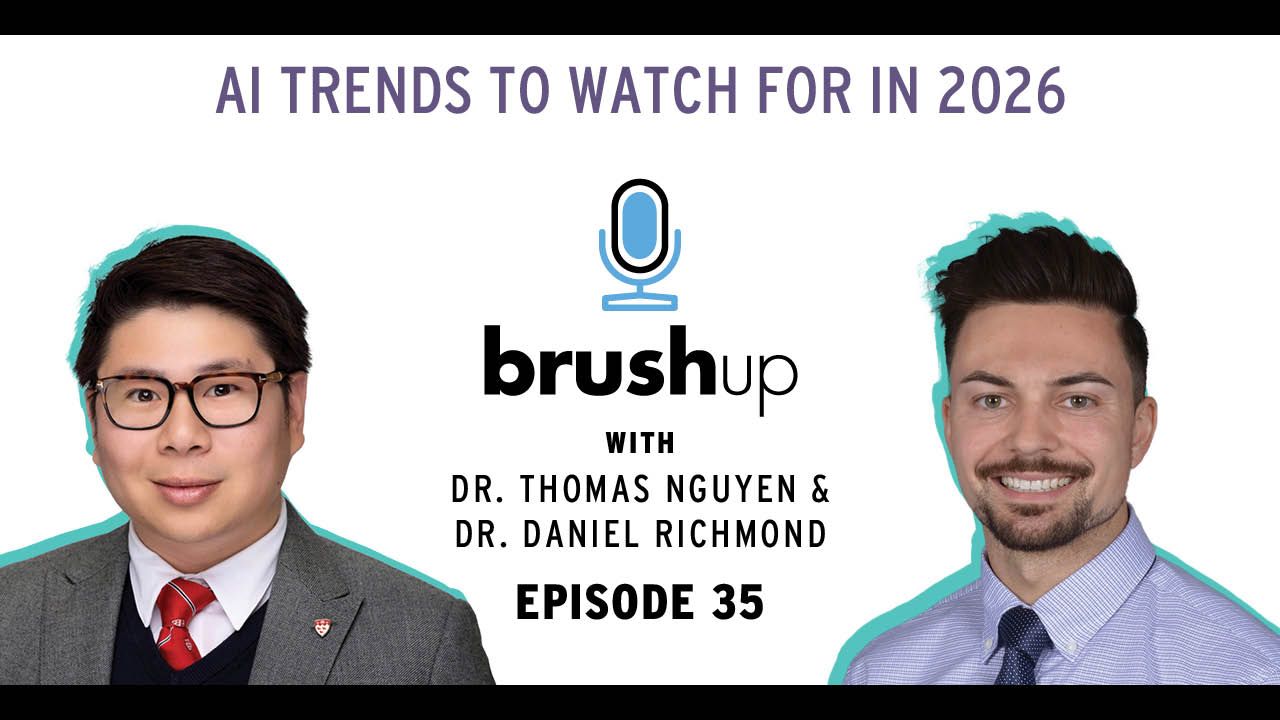
Dr. Thomas Nguyen shares some dental AI trends to look out for in 2026, including the integration of AI into dental workflows and the rise of AI-powered virtual reality in dental education. He also explores the need for proper regulation and education on AI use in dentistry to ensure ethical practices.
Read the audio transcript below:
Dr. Daniel Richmond:
Hi everyone and welcome to Brush Up, presented by Oral Health Group, the dental podcast where we speak with industry experts about the forces shaping dentistry from technology to practice management. I’m your host, Dr. Daniel Richmond, an orthodontist based in London, Ontario. In today’s episode, we’re looking ahead at the top AI trends to watch for in 2026.
Joining us is Dr. Thomas Nguyen, Director of Continuing Dental Education and Associate Director of the Division of Periodontics at McGill University’s Faculty of Dental Medicine and Oral Health Sciences. He previously served as Director of Predoctoral Periodontology at the Harvard School of Dental Medicine. Dr. Nguyen’s clinical and research work focuses on innovative technologies that improve treatment outcomes and patient experience. His research includes implant dentistry, soft and hard tissue regeneration, and artificial intelligence. He has also shared his expertise through CE webinars on AI in dentistry. Dr. Nguyen, welcome to Brush Up.
Dr. Thomas Nguyen:
Good morning, Daniel. Thank you for having me.
Dr. Daniel Richmond:
First, let’s go back in time a bit. In the summer of 2024, we saw the first fully automated dental procedure on a human, a major milestone in robotics and AI guided planning. Looking back at 2025, what would you say were the most significant AI or technology breakthroughs that genuinely moved the profession forward?
Dr. Thomas Nguyen:
Interesting. So, I think the first implant that was placed by a robot goes back to 2017. I still remember because it was in the military hospital in China. I think since then they made major breakthroughs because back then they had to change the drill bits every time. Now it was fully automatic, so we can see the leap forward.
I would say 2025 in terms of breakthroughs, what we started to see was more like a consolidation of different players and significant integration into the clinic’s workflow. Because a few years ago, the software were not that good, we didn’t have that many options. And in the recent years, was really this explosion of all the different AI companies.
So, I do think that the AI bubble is real, but what’s really different in 2025 was those players started to integrate more into our workflow for x-ray, for scheduling, for patients records, and they also started to merge together. So, I think if we fast forward more, it’s going to be almost like a one solution AI for a whole dental practice. This is technically what we’re looking forward to.
Related article: Dental ethics in the age of artificial intelligence: Global perspectives and the Saudi experience
Dr. Daniel Richmond:
Okay, very interesting. And last year you identified two key trends to watch. One is more integration of personalized health data with wearables and two, AI powered virtual reality for dental education and simulation. Where do these two trends stand today and what, if anything, surprised you about their progress?
Dr. Thomas Nguyen:
I think I was fifty percent right. One, I was a bit too optimistic regarding the virtual reality integration into dental education. I think everything at university takes more time to integrate, but we do see some of the Sim Lab getting into virtual reality more. Here at McGill, we had some work with it, not fully integrated yet, and I’ve seen at other universities also.
But what really excites me and one of my best purchases this year was, technically, you can see the Meta Ray Ban glasses, those wearable and integrated AI assistant. I think we get more and more information. I would highly recommend this to anyone, but we have this thing at home, it’s called a sleep pod where it integrates into your bed, and it cools and it gives you different biomarkers and information and data about your sleep.
And in terms of research, what I saw was people started to use those data from wearables and everyday items that we have at home. The one that concerned me the most is Imperial, they use data from an electric toothbrush from Oral B, and this can predict areas of inflammation, disease progression, pockets, and bleeding areas and where we should focus more attention on. It’s not through the app of Oral B, but they extracted the information and they did a bit of research on this. So that part was really exciting.
Dr. Daniel Richmond:
Okay, awesome. And just back to the virtual reality in dental education, do you think that this is a different way to do things? Is it better? Is it worse? Do you know how that’s going to shape up yet?
Dr. Thomas Nguyen:
So, I do think that it would be better, but we still need to merge the two together because a lot of what we do is manual and tactile and not only visual. So, the main concern is the haptic feedback when we’re in virtual reality. So, I’ve tested different products to make sure that when you probe, you feel the resistance, when you drill into a tooth, you feel the same sensation. It is close, but it’s not at a level where it would be that useful. I think in terms of workflow, this is what is really good. Like if you train your dental personnel to work through instruments and different steps of something, virtual reality is a great tool for that. So, there are some things that it’s really good at and other things that technology still needs to catch up to.
Dr. Daniel Richmond:
Okay, so it definitely has a place though.
Dr. Thomas Nguyen:
Oh yeah, for sure.
Dr. Daniel Richmond:
And as we move from 2025 into 2026, what emerging AI trends should dentists, educators, and regulators be watching most closely, and why do these developments matter?
Dr. Thomas Nguyen:
Yes. I think one of the trends that I’ve seen is it takes a lot of research and a lot of effort to put into the market a solution that can be used for diagnosis and things like that. It has to clear FDA and there’s a lot of regulation that has to clear Health Canada. But what we see is if you have a software that doesn’t diagnose someone else, but diagnose yourself, there’s no regulation there.
So, there’s a lot of application that instead of going through the regulation, they go directly to consumer. So, there’s some app that you can download to diagnose oral cancers and different diseases, and this is technically terrible because they’re not regulated and it’s potentially dangerous for patients. So, this is something that regulators have to watch out for because it’s a very big shortcut to skip all the regulation, directly to market, and then users don’t really know about like, is it safe, is it not? And they start using it. So this is something that it’s more of the concern.
Dr. Daniel Richmond:
Yeah, I’ve always been a believer that AI is, or any technology is great, but it has to be in the right hands. Someone who already has the knowledge and expertise to properly use that technology.
Dr. Thomas Nguyen:
Oh, definitely. What I say is AI is like a multiplier of expertise, so if you have some expertise, it will make you better. But if you have zero expertise, it’s not going to help you for that.
Related article: Tech stack revolution: Cloud and AI in dentistry for 2026
Dr. Daniel Richmond:
Right. And from your perspective, where is AI currently making the biggest difference in treatment outcomes, whether it’s implant dentistry, soft tissue procedures, diagnosis, are we beginning to see measurable clinical gains?
Dr. Thomas Nguyen:
Yes, so this is actually something that I’ve studied during my MBA and it’s actually very interesting. Clinics that integrated AI, and we’re talking about different AIs, there’s a receptionist, there’s cribs, there’s diagnosis, caries detection and so on. What they saw was a significant improvement in terms of performance. They reported about eighteen percent more diagnosis of periodontal disease, just because hygienists and most dentists when they work, probing takes a lot of time. When you have a voice control AI that can help your hygienist, they save a lot of time for new exams, for recalls, and that turns into more diagnosis and more treatment that can be done. They report about fourteen percent more in terms of restorative work.
So, looking at caries, seeing if they’re present or not, I think this is something that’s still very difficult to standardize across dentists. Sometimes we see something, sometimes we don’t. And AI is also a great communication tool with patients. So, they feel that the dentist is not trying to sell them a feeling, but technically educating them. And they’re very impressed by seeing the different colors on the x-ray. So, this is something that’s been reported in terms of AI in clinical practice.
Dr. Daniel Richmond:
Do you think there’s a risk of over diagnosis with that type of technology?
Dr. Thomas Nguyen:
Yes, definitely. I don’t know if we have time for this, but my thesis was actually on calibration of trust when using a new technology. So, if we don’t trust something enough, we underuse it, but then if you trust something too much, then we overuse it and there’s errors and different things that can happen. So technically the best range that we found in terms of performance and utilization is to verify the work of AI between twenty to fifty percent of the time. The people who verified like one hundred percent, you’re doing the work in double, so you’re not really gaining anything in terms of speed because you’re still redoing the work that the AI has done. And then you have at the opposite side where it’s more like new grads, they don’t have enough experience, they’re like, oh, what do I know to say that the AI is wrong? So in their case, they have a lot of over diagnosis and things like this. So, this is why education on AI and prepping the students in school in terms of how to best use AI integrated into our workflow is essential.
Dr. Daniel Richmond:
Okay, interesting. And so, on that note, as AI does become more embedded in diagnostics and imaging surgical planning, do you think that today’s regulatory and quality assurance systems in Canada and the U.S., are they keeping pace?
Dr. Thomas Nguyen:
I think they definitely have to keep an eye on what’s happening and a lot of things are at discovery stage and they try to adapt as things come. Like I’m in the board of directors for the Order of Dentists of Quebec. So, this is like the RCDSO for Ontario. And we know about the AI risks, but I don’t think anyone is really taking a step forward to put out regulations.
At the end of the day, the message that I see is AI is still a tool. So, you’re responsible for your own diagnosis. You’re still responsible for the act that you use. And this is just to help you be better at diagnosing, better at seeing different things on the x-ray. So, all the regulation on dentists still applies even if they use AI. So, this is why at this stage, I don’t think there’s any special regulation regarding AI, but we could see more coming up in the future.
There was this case in the U.S. where it was a physician who put the wrong diagnosis, but then the AI did prescribe the right diagnosis, and then there was a surgical mistake, and then the patient was suing and we’re still trying to see what’s going to come out of this, but there’s a lot of ethics. It’s a complex situation, so yes.
Dr. Daniel Richmond:
Yeah. It seems like a bit of a gray area still how to deal with it. So, shifting away from clinical a bit towards practice management, we’ve seen rapid growth in AI tools for scheduling, revenue cycle management, and patient communication. Which of these types of tools do you think are genuinely reducing workload and which should dentists maybe be approaching with caution?
Dr. Thomas Nguyen:
Yes, I think from all the interviews that I’ve done, most of them are saying that AI helped them do their job better in terms of administration, workflow and all this, reception. The only thing is there’s a period of adaptation. So, on average, it took about one point five years for your staff to get used to using this new technology and integrating it. So, they saw a period where in terms of time, it took them more time to do things in double and train the staff to use the different technology, and it’s not all integrated at this time. But then after one point five years, they saw a significant improvement in terms of time saving. And they said that even when it was slower, the quality of the work was better.
Like let’s say email response to patient was a lot easier using AI. I use a lot of Scribe in terms of interaction with patient because it records what you tell the patient and it puts it into your chart notes. So, you just do some modification, and it takes a lot less time for that.
AI receptionists also. One of the main concerns is the reception is very busy, you have to welcome the patient, you take phone calls, you check the patient out. So, a lot of time when new leads or people who are calling your office don’t get an answer, they call the next one. So having an AI receptionist 24/7 gets all the calls, it’s a very natural voice that you get, they know that it’s AI, but it can redirect you, give scheduling appointment, take out the information. So, there’s always an answer when you need to, and then it can redirect if it’s an emergency.
I think this is the best integration in terms of AI in a dental office, because diagnosis and all those things, there’s still a lot of false positive, false negative. It’s not super precise to a level that, you know, it gives you always the right diagnosis, but the AI integration helping your staff, especially in the market where we’re understaffed, it’s very hard to hire receptionist, assistant and so on. I do believe that AI is a good solution for that.
Dr. Daniel Richmond:
And do you have a couple favourite platforms or programs that you might recommend people look into for practice management side of things?
Dr. Thomas Nguyen:
So, I do think that Ontario has this recommendation for scribes and different AI software and applications, because I’ve seen this at some meetings where one of my colleagues, Peter Fritz, was presenting on. Personally, I use Heidi. It’s a medical AI software that records and writes your charts, but it’s very well adapted for the dental field. And it can also understand different languages and accents. Just because I live in Montreal, so we speak French and English, and the French Quebec accent is a bit different from the French from France, but it still worked very well.
Dr. Daniel Richmond:
Okay, interesting. You work closely with dental students and residents. How are schools adjusting their curricula to prepare graduates for AI supported clinical environments? And do you think that this change is happening fast enough?
Dr. Thomas Nguyen:
I mean, I don’t think the change is happening fast enough and I don’t think it’s also uniform across all dental schools, but for us, we’ve been working with some form of AI in clinic for a few years. We use Diagnocat to teach dental students how to work with 3D x rays like CBCTs. And we show them without the application and with the application and see the difference in terms of what they can see and what they can learn from this. And we have very positive feedback from that.
I would believe that more and more dental schools will have access to those AI softwares, especially for radiographs. But at McGill, we also created a research cluster and division of artificial intelligence and trying to include some lectures and courses on AI, but more at the graduate and postgraduate level. I think it still needs some more time to integrate into pre doctoral programs.
Dr. Daniel Richmond:
Okay. And maybe some time for them to learn the basics too before jumping into the technology as well?
Dr. Thomas Nguyen:
Yes, I think one of the main concerns that I have in terms of education is one, you need to know about AI and use the tool efficiently. So then once you’re out, you know how to use it and you can adapt to the different technology. But there’s also this concern, as an example, like I put all my emails through ChatGPT now, and when I don’t use ChatGPT, I find it difficult formulating sentences and a very good email. And this is something that is also of concern because if you’re used to doing things only with artificial intelligence, when you don’t have it anymore, you don’t know how to correct it. A bit like what we said in the beginning, you need to be an expert first to then benefit from artificial intelligence.
So there is a balance between knowing and using and still being able to do it without and to have enough knowledge and skills to know when the AI is wrong. And I don’t think that we’re well prepared for this. Right now, what I see is either we don’t teach it at all and we close our eyes and there’s no AI in school, you can’t use AI for exams or anything else, or if you start to integrate it, you have to do it safely and that’s going to be a big difficulty.
Dr. Daniel Richmond:
And so, as automation expands from planning to chairside robotics, all these things, what aspects of dentistry do you believe will always require human skill and judgment?
Dr. Thomas Nguyen:
AI has tons of hallucinations. I think the latest publications from OpenAI, they still have thirty-three to forty-nine percent of hallucinations. So, we have to be careful on that. The big thing with AI is it’s very time saving, like I said, if you’re short staffed. So let’s say an oral pathology diagnosis takes about thirty to forty minutes, but when you use artificial intelligence, and there’s a lot of studies comparing a specialist to AI, what they found was it took twenty seconds to have a diagnosis.
So huge time saving. What can you do with that time? You can see more patients, so it improves access to care, or you can spend more time with your patients because nobody likes to have, like, let’s say a cancer diagnosis from a computer. It takes a clinician, a humane approach being there to be with the patient, answer their questions and so on. So, I do think that automation and AI and robotics will help us solve a lot of problems and give us time to actually be with the patient and have a more human to human contact.
Dr. Daniel Richmond:
Yeah, I guess probably like with the scribe services too, of worrying about typing everything or taking notes, you can just be present and make a true connection with someone.
Dr. Thomas Nguyen:
Yes. And not only that, you know, for robotics, let’s say there’s regions outside of big cities where there’s no dentists, there’s a lot of problem for access to care. But let’s say if you do have, and we’re going to fast forward maybe ten, fifteen years, if you do have some type of robot that is remotely controlled from a dentist, let’s say in Toronto or Montreal, that can also help access to care and help more patients being seen.
Dr. Daniel Richmond:
And so, we’ll wrap up with one last question here. If you could offer dentists one practical takeaway for 2026, something to start watching for or preparing for today, what might that be?
Dr. Thomas Nguyen:
I think we’re at a point where AI is technically becoming more mainstream, like we see it all dental meetings. A few years ago, I was the only one talking about AI and people were like, oh wow, this is the future. And this year alone, there’s like ten, fifteen conferences that will talk about AI.
So, I think 2026 for me is the tipping point. This is where it’s not the future anymore; the future is now, and the AI solution is better than it was, more precise, more well integrated. So, it’s a good time for, I think for the general practice dentists and everyone to start using AI, because it does show that it gives you better performance, better time saving, a lot of benefits. So I do believe, or I think that 2026 will be a year where more and more people start to integrate AI into their practice.
Dr. Daniel Richmond:
Yeah. It’s like unavoidable now. Right? It’s i’s here. You have to get on with it or be left behind.
Dr. Thomas Nguyen:
Exactly. You know, they say AI won’t replace you, but for sure, someone using AI will replace you.
Dr. Daniel Richmond:
Perfect. Awesome. Well, Thomas, thank you so much for your time today, for sharing your expertise.
Dr. Thomas Nguyen:
Thank you. It was my pleasure.
Dr. Daniel Richmond:
And, to our viewers, thanks so much for listening. Be sure to sign up for Brush Up podcast alerts or subscribe on Spotify and YouTube to be notified every time we post a new episode. Keep brushing up!