
After 26 years of practice, I decided to start my own dental practice. It’s been a fun process picking colours, chairs and equipment; designing the layout; looking at new technology; and envisioning happy patients and a happy team. Then my dream bubble popped when my friend, who recently opened her office, told me she got a complaint. Public health did an IPAC investigation, and she had to temporarily close her brand-new office. She was so stressed! She took it as an opportunity to learn everything she could about IPAC so she would never face an IPAC lapse again. I took it as an opportunity to build my steri-centre correctly so I can keep my team and patients safe and never be worried about an IPAC lapse. Here is what I learned.
One-Way Flow
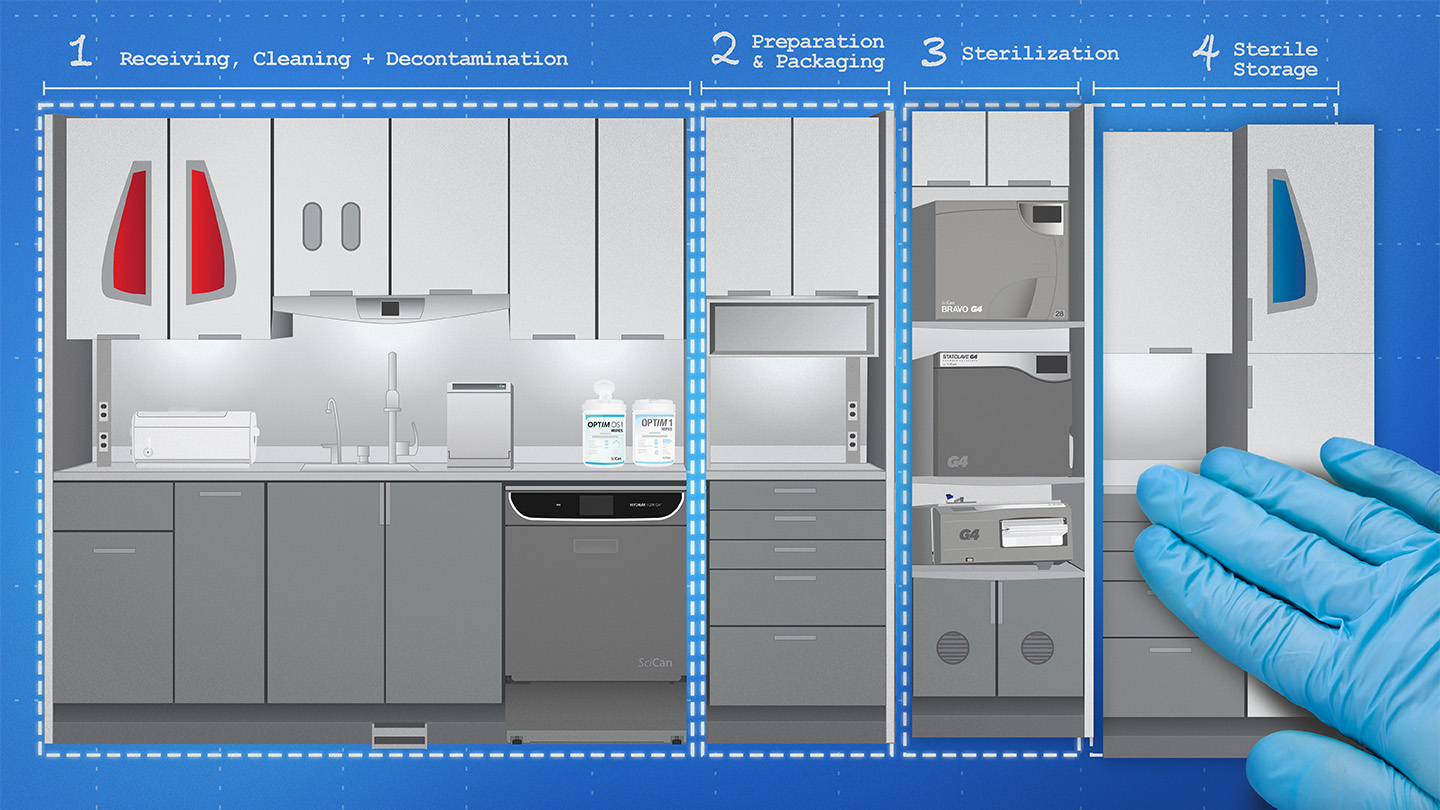
The steri-centre must have a one-directional flow of instruments from dirty to clean with clear separation of dirty and clean sides. There should be separate sections for: (1) receiving, cleaning and decontamination, (2) rinsing and drying, (3) preparation and packaging, (4) sterilization, (5) storage. When reviewing my floor plan made by my equipment supplier, my interior designer noted that the receiving area of my steri-centre was furthest away from the operatories, and that I should switch the direction from left to right to right to left. What a good call!
Sinks
I only have room for one sink in my steri-centre which means it cannot be used for handwashing. Therefore, I must have hand sanitizer in the steri-centre for handwashing. I made sure the sink is not close to the clean side to avoid splashes. If your sink is close to the clean side, install a protective barrier.
Eye Wash Station
Since I only have one sink in the steri-centre, I cannot install an eye wash station there. Instead, there will be an eye-wash station within a 10 second walk to the steri-centre in accordance with the Occupational Health and Safety Act. If you have 2 sinks in your steri-centre, an eye wash station can be installed with the handwashing sink.
Instrument Washing
An automated washer is recommended over an ultrasonic cleaner for washing instruments as they are more effective and safer. I selected the new HYDRIM 112W G4+ instrument washer because it is fast, easy to use, effective, and cost efficient compared to its competitors. I made sure there is room for the automated washer under the counter as well as space beside it for wrapping cassettes, pouching instruments and labeling them.
Surfaces
Work surfaces must be flat, cut-resistant, seamless and non-porous which can be cleaned, disinfected and dried. Ensure there is enough counter space for team members to work. This will prevent them from breaking the one-way direction of flow.
Distilled Water
Sterilizers require distilled water. I purchased VistaPure which provides 2 types of water, Deionized water for the final rinse in your HYDRIM and Distilled quality water to your sterilizers. STATIM and BRAVO can be connected directly to your VistaPure for automatic filling. For manual filling, it has a convenient handheld point and shoot wand making it easy to get distilled water for any type of sterilizer. It fits neatly under the counter saving valuable counter space and eliminates jugs.
Conclusion
I designed the ideal steri-centre which has a one-way workflow and a functional space for team members to sterilize instruments. I am confident that the team will be able to work safely and efficiently following IPAC standards when it opens next year. Now, I get to do the fun part – picking the colour of the cabinets.
References
- RCDSO – Standard of Practice Infection Prevention and Control in the Dental Office
- Public Health Ontario – IPAC Checklist for Clinical Office Practice: Core Elements
- Public Health Ontario – IPAC Dental Checklist – Reprocessing