
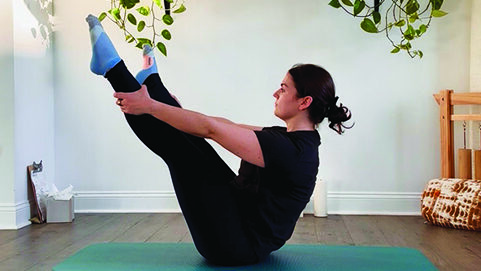
All dental professionals are familiar with the aches and pains that come from practicing dentistry. In a profession that requires extreme precision, often our ergonomics can take a back seat. Pilates can be extremely beneficial for all dental professionals, not just for their physical and mental health, but also for the longevity of their professional careers.
While you may be familiar with the term Pilates, not all Pilates is created equal. Joseph Pilates was the creator of the classical Pilates method. It was initially termed Contrology and was posthumously coined Pilates. During World War 1, Joe was held in an internment camp on the Isle of Man. While in the internment camp, he devised the Contrology system with the first set of exercises as Matwork, which is now considered the foundation of classical Pilates. He later created the original apparatus by adding springs to beds to assist in the rehabilitation of injured soldiers at the internment camp. All exercises within the system focus on the six Pilates principles: flow, concentration, centering, control, breathing, and precision.1 Joe’s method is a system of shapes in space, and each exercise prioritizes spinal mobility, core strength, and posture. So, how does Pilates help dental professionals?
1. Improves posture and spinal alignment
Pilates exercises emphasize spinal articulation and utilize various muscles to strengthen the body while also stretching those muscles. With improved core strength and the use of postural muscles, participants will notice improved posture and reduced back pain.
2. Strengthens core muscles
The classical Pilates system involves exercises that are slow, precise, and controlled. If you have taken a classical Pilates class before, you may have heard the word “powerhouse,” which is your core muscles and the center of your body that runs from your ribcage to your seat.1 Every Pilates exercise utilizes the powerhouse and strengthens these muscles in your core.
3. Reduces stress and improves mental clarity
Exercise can improve both physical and mental health and prevent many chronic health conditions. In fact, individuals who practiced the method with Joe in the internment camp were less likely to get sick during the “Spanish Flu”.2 A regular Pilates practice will help control the daily stress experienced in a dental clinic and assist in one’s mind-body awareness.
4. Enhances flexibility and mobility
A famous quote of Joseph Pilates was: “If your spine is inflexibly stiff at 30, you are old; if it is completely flexible at 60, you are young.” Daily movement improves flexibility and aids in the mobility of stiff joints. According to Dr. Bartlett of the Johns Hopkins Arthritic center, “regular activity replenishes lubrication to the cartilage of the joint and reduces stiffness and pain”.3 As oral healthcare professionals, we often work at awkward angles and are more likely to experience stiffness, especially in our upper bodies; therefore, a regular Pilates practice will help keep joints mobile and lubricated.
5. Improves body awareness and ergonomics
As mentioned previously, the original name for Pilates was Contrology, essentially a method of exercise that emphasized extreme control of all muscles in the body. In fact, Joe said, “Contrology is complete coordination of body, mind, and spirit. Through Contrology, you first purposefully acquire complete control of your own body and then, through proper repetition of its exercises, you gradually and progressively acquire that natural rhythm and coordination associated with all your subconscious activities.” This coordination of mind and body will easily translate to clinical activities and benefit you in your daily life, both inside and outside of the clinic.
References
- Peak Pilates; Comprehensive Pilates Instructor Training Manual
- Guidotti, Sara et al. “Benefits of Pilates on Depression, Anxiety, and Stress: An Observational Study Comparing People Practicing Pilates to Non-Active Controls.” Healthcare (Basel, Switzerland) vol. 13,7 772. 31 Mar. 2025, doi:10.3390/healthcare13070772
- Bartlett, Susan. “Role of Exercise in Arthritis Management.” Johns Hopkins Arthritis Center, https://www.hopkinsarthritis.org/patient-corner/disease-management/role-of-exercise-in-arthritis-management/. Accessed 8 June 2025.
About the author

Lara MacIntyre is an incoming first-year dental student at McGill. She obtained a dual degree in French and English literature from Boston University and completed a post-baccalaureate pre-dental program at Tufts University. She is a Peak Certified Pilates Instructor and has completed a comprehensive training program in both levels one and two. Follow Lara on Instagram (@lara__mac) and TikTok for more Pilates, oral health, and dental school content.