


To hit two birds with one stone—pay off student debt and gain solid experience—dental students are encouraged to try their luck in rural areas first. But that’s not everyone’s cup of tea.
“Personally, I want to work in a city center when I graduate,” said Rachel Grohovac, a dental student from the University of British Columbia. “So, that’s a little bit more of a concern,” she added.
When asked if she would be willing to work at least two years in a rural setting, Grohovac admitted the idea is “intimidating.” “Being away from your family and friends wouldn’t probably be my first choice, but I’d be open to it for sure,” she explained.
“Being away from your family and friends wouldn’t probably be my first choice, but I’d be open to it for sure.” — Rachel Grohovac
Grohovac isn’t alone. Landing the “right” associateship as a new graduate is “difficult” in a city, says Jaskaran Beniwal, a final-year dental student at Western University.
For Beniwal, it all depends on finding a practice that’s “okay with a little bit slower pace of a new graduate learning and slowly producing,” and one that’s willing to mentor them for at least six months to a year until they become profitable for the office.
Number of dentists to students is rising
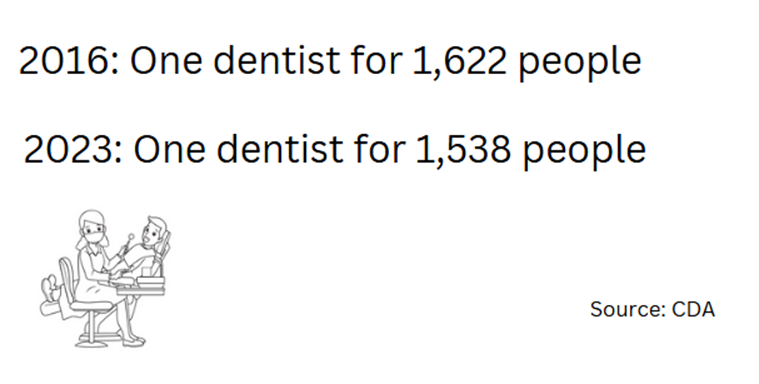
One piece of advice that recruitment agencies and financial specialists are offering students is to consider rural areas, especially if they prioritize paying their student debt quickly. After all, the number of dentists has been rising relative to the population, especially in urban centers. In January 2016, there was one dentist for every 1,622 people, but by 2023, this ratio changed to approximately 1,530 people per dentist. This shift reflects an increase in foreign-trained dentists immigrating to Canada, more graduates from Canadian dental schools, and initiatives to address shortages in underserved areas.
“Working in a rural practice can offer those opportunities, as many have more downtime.” — Sana Arshad
As the disparity in access to dental care between cities and rural regions persists, urban areas are already congested with “too many practices,” said Sana Arshad, CEO and founder of Arshad Dental Consulting CPA.
“For new grads, one of the hardest challenges is paying off their debt and even getting jobs,” Arshad said. “They have to consider not being in the most populated areas.”
“While a practice might hire an associate, they often don’t have enough patients for them. The systems and processes in place may also be lacking,” she explained. “As a result, these associates aren’t earning enough because there isn’t sufficient work or a steady flow of patients to care for. It becomes a situation where time is spent, but the income isn’t enough to manage debt repayment.”
For Arshad, heading to rural areas doesn’t just help pay off debt “quickly,” but also allows an opportunity to travel and earning solid dental experience.
“Many of us feel burnt out after school and want to not only repay our loans but also take time to travel before committing to something like ownership,” she said. “Working in a rural practice can offer those opportunities, as many have more downtime. For example, some close for three weeks over the holidays. It’s about considering whether those factors align with your goals.”
Weighing rural vs urban part of a strategy
At the Canadian Dental Student Conference (CDSC) in Vancouver on Jan. 10-11, Alex Zlatin, CEO of Maxim Software Systems and founder of the Dental Office Managers Association of Canada, led a session titled 5 Ways to Pay Off Your Student Debt Faster. One of the strategies he discussed was comparing the benefits of working in rural versus urban settings.
For some students, going the rural and even heading to the United States is a step that they’re looking to take.
“Here at the student conference, these students want to go more rural,” said Kimberly Pacula, a tenured dental recruiter, and CEO of Recruit North America, on the sidelines of the CDSC. “Why? Because production is higher, they see more patients, and they gain experience faster.” However, Pacula, whose company not only helps with recruitment for all roles within a dental practise but also with retention through consultation, clarified those who prioritize staying close to family, they take that into account as well. “That’s why we’re here.”
The impact of inflation and student debt
The new generation of dentists is also facing a different financial landscape due to inflation.
While inflation in Canada has dwindled to 1.8% as of December 2024, down from its 8.1% peak in June 2022— a 40-year high —essentials like groceries have seen significant increases. The consumer price index (CPI) for food in Canada reached 190.5 in July and October 2024. The CPI for food has generally increased since 2000, with 2002 as the base year (index = 100).
“Anecdotally, every generation coming out of dental school feels like they’re facing the highest costs.” — Andrew Benzel
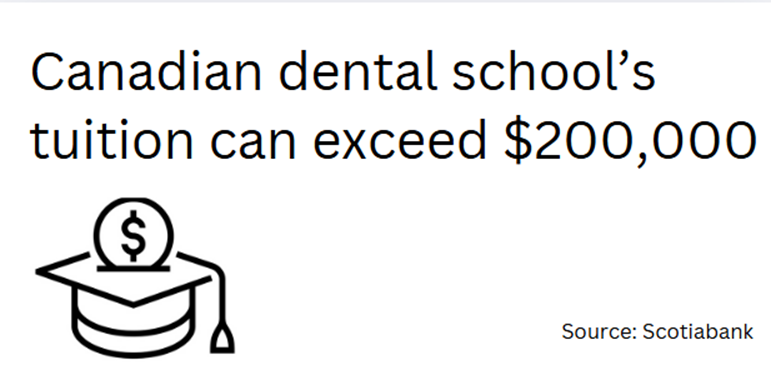
This is reflected in tuition costs. The price of a four-year degree from a Canadian dental school can exceed $200,000, a figure cited by Scotiabank. Rising inflation and interest rates have pushed this figure up from a 2006 study, which estimated dental school debt between $96,000 and $104,000 for a four-year program.
The average debt for Canadian dental students varies significantly depending on the institution and individual circumstances. When factoring in living expenses, total debt can reach $350,000.
“We see a lot of new dentists coming out of dental schools with significant debt,” said Andrew Benzel, territory manager for A-dec, a company that helps dentists purchase equipment through its Smart Start discount program.
“Anecdotally, every generation coming out of dental school feels like they’re facing the highest costs,” added Benzel. “Certainly, with high interest rates, high exchange rates, and the overall cost of things today, the current group likely feels they’re dealing with the toughest financial situation. And in terms of total dollars, that may be true. But relative to the broader economy, it’s hard to say how that compares over the last 20 years.”
Last year, Statistics Canada reported that the dental sector had surpassed its pre-pandemic productivity levels, achieving an $851-million increase compared to 2019. The data showed that in 2021, total dental economic output rose 22.7% from the previous year to $19.0 billion. In addition, dental office jobs increased by 24.1% (23,635 jobs), bringing employment in the industry above pre-pandemic levels.
Despite the financial hurdles, Beniwal remains optimistic.
“I feel like at the end of the day, you’ll be fine as long as you put the hard work in,” he said.