
Over the past two years, growth in total health spending has outpaced economic growth, pushing up Canada’s health expenditure-to-GDP ratio, the Canadian Institute for Health Information (CIHI) says.
CIHI’s National Health Expenditure Database (NHEX) includes finalized 2023 spending data and preliminary estimates for 2024 and 2025, based on public-sector main estimates and budgets.
In 2025, health spending is forecast to rise 4.2 per cent, while the economy is expected to grow 2.6 per cent, largely due to global uncertainty affecting exports, investment and business confidence. As a result, total health expenditure is estimated at 12.7 per cent of GDP.
1) Health spending is projected to reach $399 billion in 2025
Total health expenditure is forecast to grow 4.2 per cent in 2025, reaching $399 billion, CIHI says.
For context, CIHI projected total health expenditures would reach $372 billion in 2024 — or $9,054 per Canadian.
2) Health spending is expected to grow faster than the economy
CIHI says health spending growth has exceeded economic growth in each of the past two years, increasing the health expenditure-to-GDP ratio. In 2025, that ratio is estimated to rise to 12.7 per cent.
3) Per-person spending varies widely by province
In 2025, total health expenditure per capita is forecast to be highest in Nova Scotia ($11,617), Newfoundland and Labrador ($11,109) and Manitoba ($10,868), and lowest in Ontario ($9,045), Quebec ($9,320) and New Brunswick ($9,431), CIHI says.
4) Public-sector funding remains the majority share — and policy shifts could reshape where dollars flow
CIHI estimates the public sector will account for 71 per cent of total health expenditure in 2025.
CIHI also points to several developments that could shift spending between public plans, private insurance and out-of-pocket payments — including the Canadian Dental Care Plan (CDCP). As of Nov. 30, nearly six million Canadians had been approved for coverage, about 3.5 million had received dental care, and the majority of oral health providers were participating, one year into the program. CIHI also highlights early national pharmacare agreements signed by July 2025 with Prince Edward Island, Manitoba, British Columbia and Yukon.
Related: N.B. Dental Society says staff shortages limiting impact of CDCP
Provinces are also increasingly funding some surgeries through private clinics — most commonly cataract procedures — while investing to expand surgical capacity in hospitals. CIHI reports 348,590 cataract and other lens surgeries in 2023–24, with an average hospital cost of $4,380 per surgery.
5) Two cost pressures to watch: AI adoption and tariff-driven supply shocks
CIHI flags artificial intelligence as a potential cost driver and cost saver: tools such as AI scribes may reduce administrative workload, but can raise short-term costs for integration, training and data security.
It also warns trade tensions and tariff uncertainty could add volatility to prices for medical devices, equipment and pharmaceuticals, including spillover effects from U.S. drug pricing policy and potential impacts on Canadian generic drug supply.
Canada’s position internationally
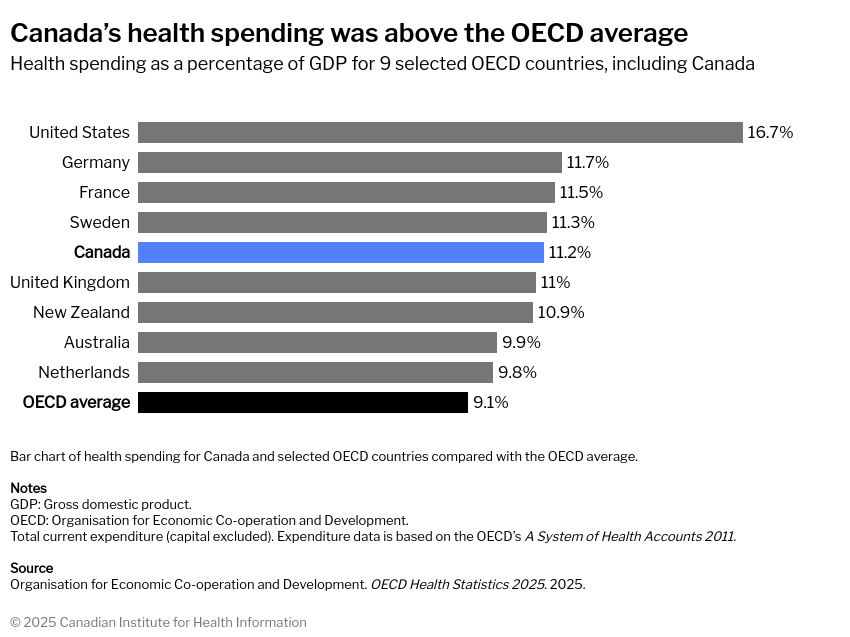
In 2023 (the latest year with comparable OECD data, according to CIHI), Canada’s health spending as a share of GDP (11.2 per cent) was above the OECD average (9.1 per cent). CIHI notes the U.S. had the highest ratio (16.7 per cent) and places Canada among higher-spending peers such as the United Kingdom, Sweden and France.