


What outsiders see that insiders miss
Same asset. Different lens.
Over the holidays, my family skied in Whistler. The mountain was busy but not with locals. Most of the people on the lifts were international travelers: Americans, Europeans, Australians. Families who understood something simple that many Canadians nearby seemed to overlook. At a 30–40% currency discount, Whistler is not expensive to them. It is a bargain.
That perspective shift was instructive.
The more interesting observation is this: the people closest to an asset often see only its friction, while those willing to step back can see its value more clearly.
Same mountain. Same snow. Same experience.
Different lens.
This pattern shows up everywhere, including dentistry.
Choosing unkind truths over kind lies
Kind lies feel easier in the moment but degrade system performance over time. Unkind truths create short-term discomfort while strengthening the system long term.
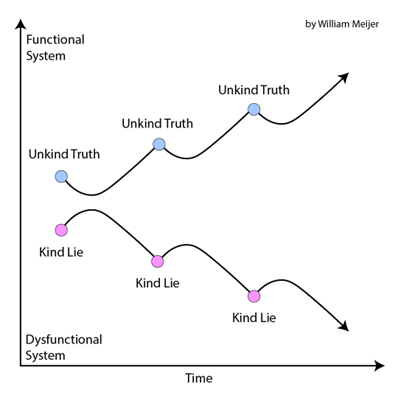
This graph by William Meijer illustrates is how individuals, businesses, and even entire industries drift into quiet underperformance. They choose kind lies over unkind truths.
If a truth will eventually need to be said, it should be said at the smallest possible scale. In practice, that means:
- Giving feedback when it is a sentence, not a termination
- Addressing misalignment when it is awkward, not explosive
- Naming the problem while it is still reversible
Avoiding discomfort does not preserve harmony. It simply defers conflict—and increases its eventual cost.
One observation that has stayed with me came from a social media post that described the problem succinctly: the longer a “kind lie” persists, the more force is required to correct it later. And the very culture that allowed the lie to exist is often the one least capable of tolerating the correction.
Kind lies do not disappear.
They hide. They compound. They wait until addressing them is no longer optional.
Why outsiders often see opportunity first
What people often call “luck” in business or wealth creation is rarely random. It bends toward those who have positioned themselves to see opportunity differently. If you want to understand where opportunity forms, do not start with markets. Start with perspective.
Research across disciplines points to the same pattern. Face-to-face interactions outperform distant communication. Innovation clusters geographically. Economic mobility increases when people cross social and professional boundaries. Operating performance improves when trust and proximity exist among decision-makers.
Economists call this agglomeration—the idea that productivity and insight increase when people and ideas cluster. But beneath the data is a quieter truth.
Those inside a system tend to normalize its limitations. Those outside it are less emotionally attached and therefore more objective. The outsider is not necessarily smarter. They are simply less invested in the status quo.
A question worth sitting with
The most valuable assets are often underestimated by the people standing closest to them.
Where dentists often misread their own practices
Many dentists believe that working harder will eventually expose them to opportunity.
It will not.
Opportunity does not visit people who are always unavailable. It visits people who are present, in the right rooms, having the right conversations.
Isolation feels safe. But it quietly caps upside.
When a dentist’s world consists only of the operatory, the staff, and the existing patient base, the future tends to resemble the present, just more exhausting.
From the inside, many dentists see their practices as a collection of problems:
- Staffing challenges
- Overhead pressure
- Regulatory burden
- Physical and mental fatigue
They experience the business through friction.
Others, often outsiders, look at the same practice and see something else entirely:
- Durable cash flow
- Recession resistance
- Predictable demand
- Systems that could be optimized
Same practice. Different lens.
The dentist feels the weight. The outsider sees the asset. That gap in perception is where leverage is created.
Stepping back without stepping away
The solution is not detachment. It is distance.
The most effective practice owners learn to periodically step back far enough to see their businesses as assets, not obligations. They seek environments where different perspectives are present, where assumptions can be challenged, and where unkind truths are surfaced early—before they become expensive.
As uncertainty increases, many people chase trends. Disciplined operators do the opposite.
Jeff Bezos famously built Amazon by focusing not on what would change, but on what would not.
As he has said, he is almost always asked what will change in the next ten years. And almost never asked what will stay the same. He argues that the second question is the more important one. Customers will not wake up one day wanting higher prices, slower delivery, or more friction.
Technology evolves. Markets shift. But human behaviour is remarkably consistent.
The most valuable businesses are not built on prediction. They are built on constants. That principle applies whether you are running a dental practice, buying one, or thinking seriously about what you want the next decade to look like.
Final thought
Proximity is powerful—but it can also be blinding. The practice you experience every day may look heavy from the inside. From the right distance, it may look like an asset waiting to be properly seen.
The question is not whether opportunity exists. It is whether you are standing close enough to manage—or far enough back to recognize it.
About the author

Dr. Galia Anderson graduated from the University of Toronto’s Faculty of Dentistry and built a successful private practice in Vancouver, British Columbia, where she served patients for 15 years. Today, as the founder of Dental Business Experts, Dr. Anderson is committed to empowering dentists to achieve substantial growth in their practices.