


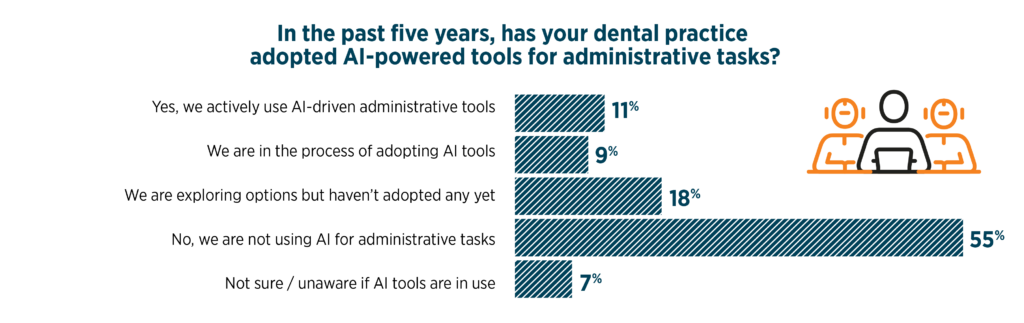
Oral Health’s recent Data Driven Dentistry survey of practicing Canadian dentists revealed that 55% of respondents are not using AI tools for administrative tasks. This finding demonstrates that despite the hype surrounding AI in dentistry, a significant gap in adoption remains.
AI practice management tools can help improve productivity and streamline workflows, freeing up time for dental staff while also enhancing patient communication. AI chatbots and virtual phone agents are just two examples of how practices can leverage these tools. In fact, a recent study from Permanente Medical Group found that 47% of patients reported their doctor spent less time looking at a computer during visits thanks to the use of an AI scribe, improving the patient–physician relationship.
Despite the many ways AI can reduce administrative burden, only 11% of our readers are currently using it. However, some dentists fall into a middle ground, with 9% in the process of adopting AI and 18% exploring their options. This suggests that while interest in AI tools exists, certain barriers are slowing adoption.
What are those barriers?
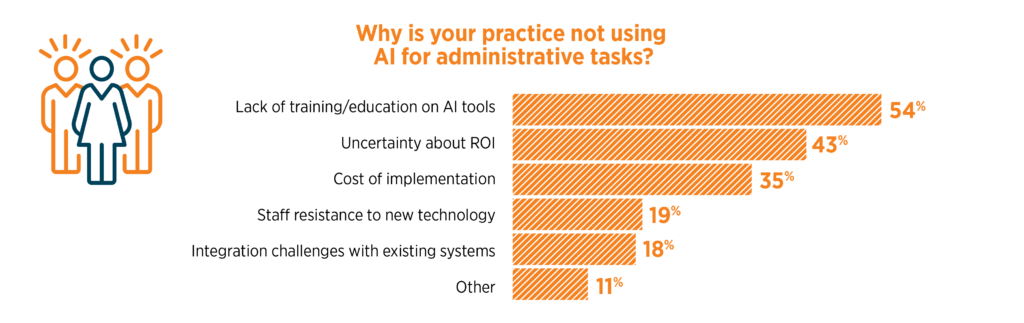
A lack of education and training is the most commonly cited reason dentists are not yet using AI tools for administrative tasks. Without a clear understanding of what these tools do and how they work, practice owners are understandably hesitant to introduce them. While the goal is to improve efficiency, insufficient training could instead place an additional burden on the dental team.
Uncertainty around return on investment and implementation costs also play a significant role in adoption decisions. Despite AI’s potential value, new software and technology represent added expenses at a time when many practices are operating within tight budgets. Practice owners want confidence that any investment they make will deliver measurable benefits.
AI in dentistry is not going away, but its integration is likely to be gradual, with careful consideration from practice owners. For AI to become a standard part of dental practice, vendors and industry leaders will need to prioritize education and implementation support. In the meantime, dentists are encouraged to evaluate and explore AI’s potential for their own practices and stay informed by reading more about AI in dentistry from Oral Health.
Subscribe to Oral Health’s bi-weekly Data Driven Dentistry e-newsletter.