


“I think 2026 is the tipping point. It’s not the future anymore,” said Dr. Thomas Nguyen during a recent appearance on Oral Health’s Brush Up Podcast. “The future is now. It’s a good time for general practice dentists—and everyone—to start using AI.”
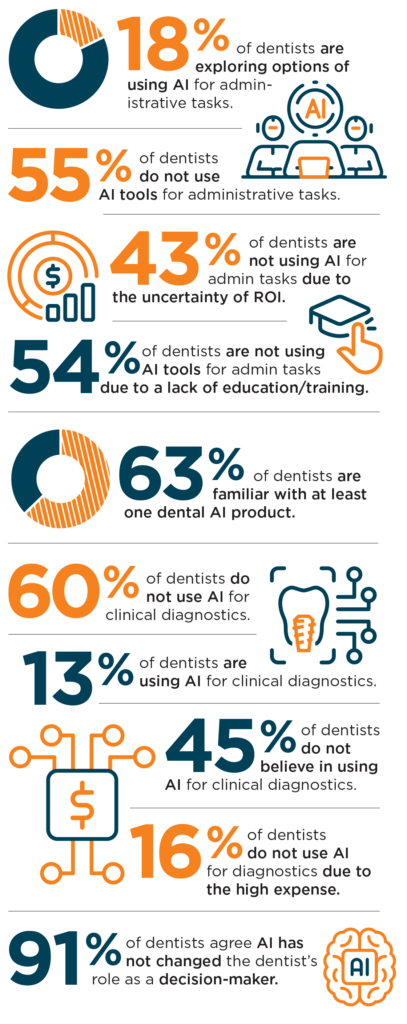
Despite growing interest, many dentists remain cautious. When asked whether they had implemented AI-assisted technologies for clinical diagnostics in the past five years, 60% of Canadian dentists said they had not. While AI is gaining broader acceptance within the profession, this hesitation highlights ongoing concerns around adoption. Still, 37% of respondents have either implemented AI for diagnostics or are actively interested, indicating that momentum is building—albeit gradually.
For nearly half of dentists not using AI for clinical purposes, the decision comes down to belief: they do not feel AI should be used in this way. This reflects a key principle in the AI conversation—AI should support, not replace, clinical judgment. Dentists remain the final decision-makers, with AI serving as a tool to enhance accuracy and efficiency rather than one to be trusted blindly.
For those hesitant about AI in diagnostics, practice management tools offer a practical entry point. Dr. Nguyen noted on the podcast that solutions such as AI receptionists can help address staffing shortages by answering questions, redirecting patients, and managing scheduling. By reducing administrative strain, these tools allow staff to focus more on in-person patient care, improving both patient satisfaction and practice performance.
As seen in the print issue of Oral Health February 2026
From October 15, 2025 through November 13, 2025 Bramm Research, a third-party independent research house, conducted an online survey of active, practicing, non-hospital affiliated dentists and dental specialists on behalf of Oral Health. Survey invitations went out to a contact list of approximately 9,000 readers and there were 164 completions, for a response rate of 1.8%. With a total sample of 164, the margin of error is plus or minus 7.6 percentage points at the 95 percent confidence level. If, for example, 50% of the sample indicated that agreed with a statement, then we can be reasonably sure (19 times out of 20) of an accuracy within +/- 7.6%. This means that a total census would reveal an answer of not less than 42.4% and not more than 57.6%.
Sponsored by