
While dentistry has seen many technological advancements over the years, artificial intelligence (AI) is undoubtedly one of the most talked-about developments in recent times. At Oral Health, we’ve published numerous articles exploring how AI can be integrated into dental practices to enhance experiences for both patients and professionals. We’ve also examined the potential risks of overreliance on AI—and emphasized that, ultimately, dentists must remain the final decision-makers when it comes to patient care.
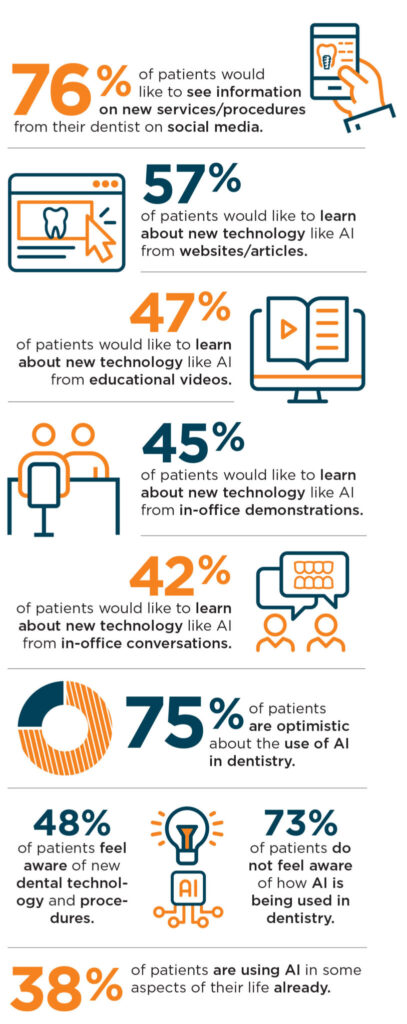
But how do patients feel about the prospect of their dentist using AI? Interestingly, while three-quarters of Canadian dental patients admit they are unaware of how AI is being used in dentistry, nearly the same number say they feel optimistic about its potential. AI is a widely discussed topic across many industries, and most Canadians are already familiar with it in some form. In fact, 38% of dental patients reported that they are already using AI in other aspects of their daily lives—and chances are, you as a dental professional are too.
Still, most patients remain largely uneducated about the specific ways AI can enhance their oral health. If you’ve implemented AI tools in your practice, consider sharing educational resources—whether created by you or by the AI systems you use—on your website or social media platforms. The data clearly shows that patients are curious and open to learning more.
Read related article: The best way to educate your dental patients about new technology
As seen in the print issue of Oral Health September 2025
In 2024 Bramm Research, a third-party independent research house, conducted a confidential online survey of general population Canadians who have visited a dentist within the past two years. The survey was limited to those 25 years or older, and nine age brackets were filled proportionally to the Canadian general population. Provincial proportions were also filled to proportionally represent English speakers in Canada of age 25 or higher. The target sample for gender was 50% female and 50% male. The survey launched on Friday, September 20th and closed on Thursday, October 3rd for a total of 14 days in field, and the number of completed responses was 1,000, the same as in 2019. With a total sample of 1,000, the margin of error is plus or minus 3.1 percentage points at the 95 percent confidence level. If, for example, 50% of the sample indicated that agreed with a statement, then we can be reasonably sure (19 times out of 20) of an accuracy within +/- 3.1%. This means that a total census would reveal an answer of not less than 46.9% and not more than 53.1%.
Sponsored by
