

Leadership roles in dental hygiene are often overlooked. Whether it’s being the owner of your own clinic or taking ownership of the practice you work in, your leadership style may be well positioned for entrepreneurship.
Leaders are individuals who guide, inspire, and influence others toward a shared vision. They embody traits like integrity, empathy, resilience, and decisiveness. Leaders not only set direction but also foster collaboration and empower team members. All dental hygienists have some or all of the traits of a good leader—this is what you do in clinic every day.
We all fall into various categories of leadership roles even outside the operatory. Business owner, educator, speaker, mother, father, friend.
What kind of leader are you? There are many different leadership styles but we’re going to look at the most common to help you decipher where you fit.
A delegative leader trusts and rely on their employees to do their jobs. This type of leader doesn’t micromanage, but the downfall of this type of style can be a challenge when employees are seeking feedback as they tend to be less communicative in nature. While there is some freedom working with delegative leaders, there can be conflict when communication breakdown occurs.
Participative leaders are inclusive; they like everyone to be involved in the decision-making process. They are good communicators and like to share responsibility, supporting a democratic atmosphere. This type of leadership style encourages a team mentality and empowers a team culture. This can sometimes delay crucial decisions in the eye of fairness.
Authoritative leaders are hands on motivators. Team members take inspiration from this type of leader as they provide direction and guidance. They like to know each member of a team and provide more personalized feedback. The drawback of this type of leader is it can feel like micromanagement and perceived as little to no trust in the team.
Transactional leadership relies on metrics and achievement. They develop rewards-based systems with clear goals. Team tasks are very specific and if not achieved there is no reward and possibly even punishment. If goals aren’t achievable, the team often become apathetic and less engaged.
Looking to the future, transformational leaders focus on change to achieve the goals of a team. Inspiring, this leader is comfortable with change and understands learning and trying new processes and systems that will lead to success. They see the potential in each member of the team. They will give goals to each team member and focus on individual strength. A downfall of a transformation leader is they can often be perceived as scattered and impulsive.
Servant leaders believe the needs of the many outweigh the needs of the few. Relationships are central and they want team members to reach their full potential. They use an ethical model to make decisions about the future and team and take each member’s ability to contribute to problem solve into account. Understanding each member of a team creates a stronger loyalty and will lead to more consistent success in goals and metrics.
Dentists and dental hygienists are so well educated in their craft, but does the curriculum have a leadership or practice management course or an all about entrepreneurship component in the program? Some do, but most don’t. When I went to dental hygiene school it was not a focus in the dental hygiene course load at all. Frankly, the business of dentistry wasn’t either. I felt unprepared for the job force with the exception of being confident in my skills. Up until 2007, in Ontario at least, dental hygienists had to go through a lot of hoops to own their own business, so not many did until we became self-initiated—now an archaic term as well.
Once you understand the type of leadership style you might fall into—and we can be a little of all of them but one will resonate with you—can you think about how those feed into entrepreneurship?
A Day in the Life of an Entrepreneur
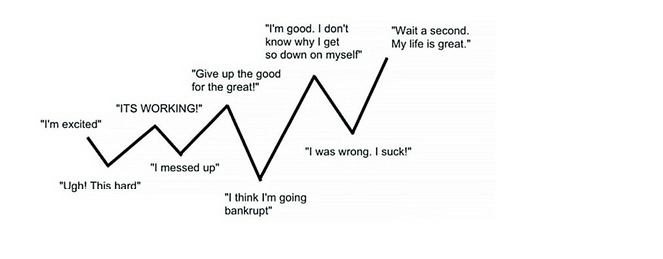
Darren Hardy writes about the roller coaster of entrepreneurship and, taking his knowledge, I think of my experience as a business owner in my 6th year and what part of the ride I’m on.
The start is the climb or the ascent. The excitement of getting somewhere unexpected and how you’re going to get there. Fuelled by ambition and grit! The dream, the business plan, your vison of what it can and will be! Two ops? Five ops? Logos, websites, socials. DREAM BIG because the other side is going to be GREAT!
But then there’s the first drop and reality hits. Things might cost more than you thought, maybe a hidden cost in construction you weren’t aware of, and where are the patients? Why isn’t there a line at the door? What have I done?
Usually what comes next is a few loop-de-loops, the highs and the lows are constant. YES! Five new clients this week but, wait, the chair in the second operatory isn’t working and we’ve lost two of those new clients because we had to reschedule them and they went to the next clinic. Ten-hour days seem to go on and on, around and around—symptoms of burnout begin and the vision of why you started seems a distant horizon in the rear-view mirror.
And then you plateau. Growth slows, you’re stuck and wondering what’s next or if you should even keep going. You start to reflect on new goals and second guessing your vison and goals. Change begins when plateauing.
The final climb has you inspired again, rebranding or refining your vision. Defining the who and what of what your business has become and where it’s going. Growth starts again, the team builds, and you trust your own decisions more.
The ride continues but your seatbelt is more secure.
So, what’s stopping dental hygienists from opening clinics? Why are new graduate dentists taking longer to open practices?
The answers are simple. We have an aversion to loss, and we feel loss more strongly than gains, so taking the risk is scary. The unknown often holds us back and jumping off might be chaos, but control is more comfortable.
We are designed to think that uncertainty is dangerous, but personal growth might mean leaving a stable paycheck that has stunted you. The financial risk can be big but planning is key.
We must start looking at failures as a learning experience. Entrepreneurs who have experienced failure are more prepared for challenges of entrepreneurship than those who have only enjoyed success. The idea of failing forward, being a part of success means you’ve learned from it, adapted, and you can forge ahead.
The benefit of being in our profession is we have choice and what you’re not changing you’re choosing. The sweetest thing in dental hygiene is autonomy. The choice to be where you are and where you are going.
In my opinion, the best thing about being an entrepreneur is choice.
 References
- Cope, J. (2011). Entrepreneurial learning from failure: An interpretative phenomenological analysis. Journal of Business Venturing, 26(6), 604–623.
- The Set-Up-To-Fail Syndrome, Jean-François Manzoni and Jean-Louis Barsoux Harvard Business Review , April 1998
- The 6 most common leadership styles & how to find yours, International Institute for Management Development
- The Entrepreneur Roller Coaster, Darren Hardy, Greenleaf Book Group, LLC June 2019 @nd Edition ISBN-10 : 1733513302
- Annual Future of Dentistry Survey, Dental Industry Association of Canada and Eric P. Jones & Associates Nov, 2013.
- Entrepreneurial learning from failure: An interpretative phenomenological analysis. Jason Cope, Journal of Business Venturing, Volume 26, Issue 6, 2011, Pages 604-623
About the author

After leaving a career in Performing Arts Marketing, Joe began his journey in dental hygiene and oral health in 2006. Joe has been practicing Myofunctional Therapy for over 10 years and it has become a passion in his daily practice, utilizing sleep dentistry, airway concepts and functional health to help his patients pursue optimum health. An international speaker and educator, Joe believes that all RDH’s should identify as educators. At the forefront, we are health educators. Joe is proud to be a part of the ever-evolving profession of dental hygiene. Joe is a lead presenter and speaker at rdhu Inc., a cross Canada continuing education group for RDH’s. He is the creator of their myofunctional therapy curriculum geared for dental hygienists. Joe currently operates and owns Kingsmill Dental Hygiene and Orofacial Myofunctional Therapy in Toronto, Canada