
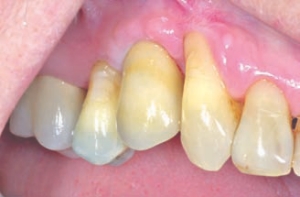
There are many times when anatomic landmarks interfere with the placement of dental implants — especially in the posterior maxilla. The maxillary sinus originally starts in us as children about the size of a pea and gradually increases in size as we mature through pneumosis. This ‘air space’ can be partially turned back into bone at its lower aspect through a process call ‘Sinus Augmentation’. There are actually four categories of sinus augmentations.
The ‘SA-1’ is the first category. In this situation, there is ample bone into which the implant(s) can be placed without interfering with the Schneiderian Membrane of the Maxillary Sinus. There is approximately 12mm of host bone or more.
The ‘SA-2’ — (the topic of this case study) — is the situation where there is almost sufficient bone for implant placement, but not quite enough. There is generally 10 to 12mm’s of host bone available, but a small amount of bone is required beyond this amount so that the Schneiderian Membrane is not violated during implant placement.
The ‘SA-3’ category is the situation where there is 5 to 10mm’s of bone available into which the implant can be placed. This is obviously insufficient, and will require a full ‘Tatum lateral wall’ approach to gain enough host bone and foundation into which the implant(s) can be placed. This situation has enough residual bone to allow placement of the implant(s) at the same time as the sinus membrane is elevated, thus reducing the number of surgeries and morbidity for the patient. There is of course more risk with this double surgery, since an infection in the sinus surgery would affect the host bone and the implants that were placed.
The last category, the ‘SA-4’ has little to no host bone available for implant placement (5mm’s or less) and all of the bone lost through pneumosis of the sinus must be regenerated by grafting. Implants should not be placed in this situation since
there is very little existing bone left to stabilize the implants that are placed. Micro-movement of the implant can prove to be disastrous.
This article will deal with the ‘SA-2″ sinus augmentation procedure. Although it looks very simple, violation of the Schneiderian Membrane can easily occur. This in turn can increase the risk of infection tremendously, and since there is usually communication between most of the air sinuses in the head, infection in this area can prove disastrous. As mentioned earlier, only two to three millimeters of extra height can be gained in the host bone allowing a longer implant to be placed. If there is any more than three millimeters required, the standard ‘Tatum sinus lift’ SA-3 procedure should be employed. The following is a case study of such a procedure, illustrating great results without complication. OH
Dr. Nicolucci is president of the Canadian Society of Oral Implantology and is Oral Health’s editorial board member for Implantology.
Oral Health welcomes this original article.
———
The maxillary sinus originally starts about the size of a pea and gradually increases in size as we mature through pneumosis