
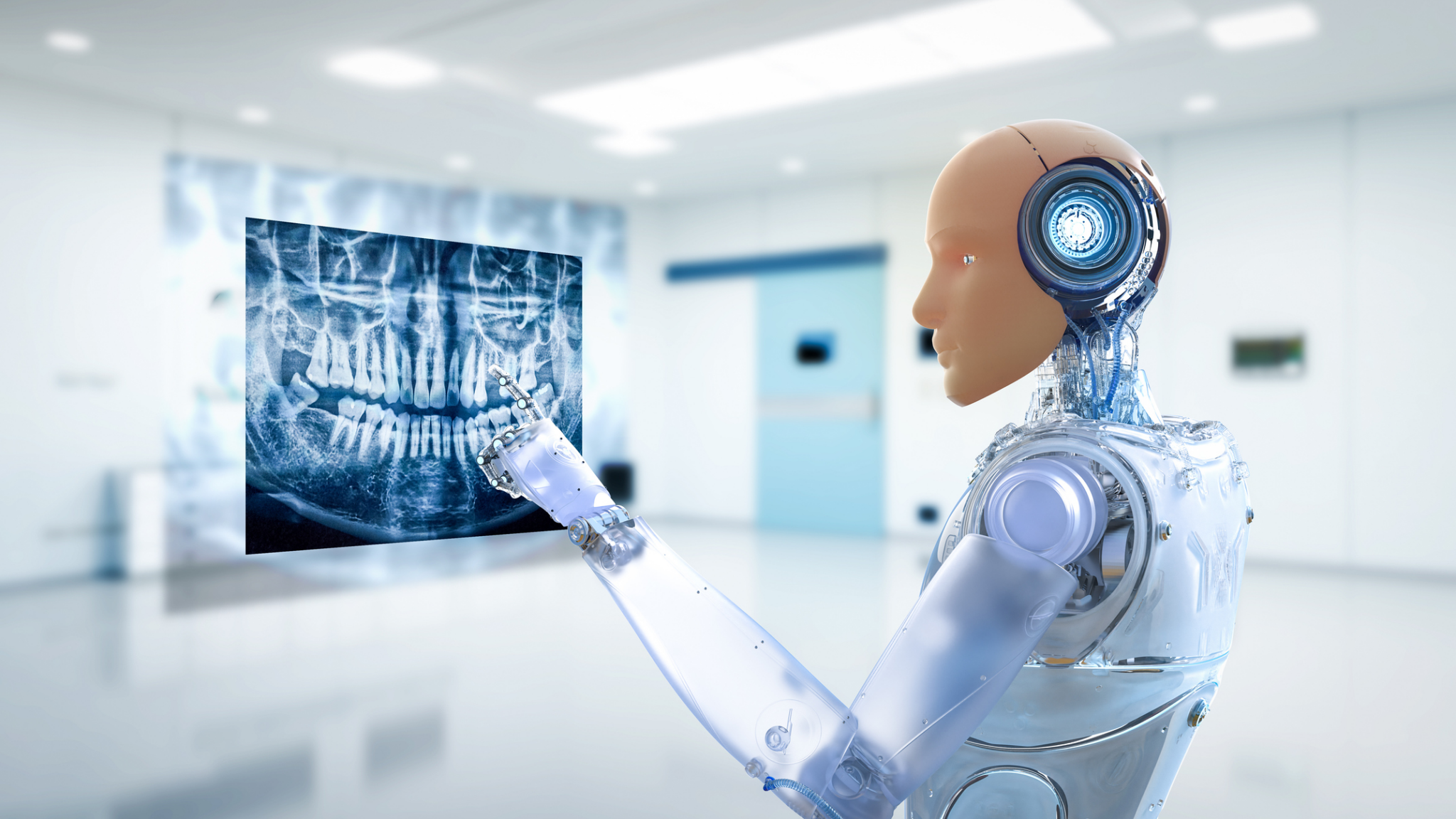
Artificial Intelligence (AI) is fundamentally changing dentistry, moving from curiosity to clinical necessity. We’ve talked about digital workflows, imaging tech, and paperless systems for years.
But what’s coming next is not incremental. It’s exponential. To fully grasp what this means, we need to revisit the foundations.
AI, in its broadest sense, refers to the idea that machines can perform tasks that typically require human intelligence. This isn’t new. In 1950, Alan Turing asked a simple but profound question: “Can machines think?” His idea, what we now call the Turing Test, became the earliest benchmark for machine cognition. Throughout the decades that followed, computer scientists built on that vision, experimenting with rule-based logic, early neural networks, and primitive learning algorithms.
In 1986, Geoffrey Hinton laid the foundation for deep learning – technology that today powers nearly all serious AI systems, including those used in medicine and now, finally, in Dentistry. Fast forward to today, and we find ourselves face to face with a different kind of intelligence.
One that doesn’t replace dentists but challenges us to redefine what a modern clinician can be. AI systems today can identify caries on radiographs more consistently than humans. They can measure bone loss pixel by pixel with no fatigue, suggest treatment plans based on hundreds of thousands of cases, and even anticipate complications before symptoms appear. These are not small enhancements – they’re paradigm shifts. “For the first time, we’re entering an era where a solo practitioner can have access to the kind of diagnostic insight that used to require a team of specialists and years of pattern recognition.”
“This is about augmentation – about a new class of clinical intelligence that strengthens human decision-making, not displaces it.”
But let’s be clear. This is not about robots taking over your practice. This is about augmentation – about a new class of clinical intelligence that strengthens human decision-making, not displaces it.
The real question is not “Will AI replace dentists?” but “Will dentists who use AI replace those who don’t?” For the first time, we’re entering an era where a solo practitioner can have access to the kind of diagnostic insight that used to require a team of specialists and years of pattern recognition.
A single AI-enhanced dentist in a rural or underserved area can now offer care that rivals the most advanced urban clinic – because the diagnostic backbone is no longer limited to human experience alone. It’s informed by millions of cases, trained on global datasets, and refined with every scan. This is what we call clinical leverage. This is how technology becomes a great equalizer. And the change is already underway.
Related article: AI in dentistry: Complementary, not competitive
Some practices are quietly replacing legacy imaging systems with AI-native platforms. Some are using predictive analytics to flag high-risk patients before they even step into the chair. Others are integrating natural language processing to simplify documentation, or AI-powered communication to triage urgent cases through teledentistry platforms. These aren’t ideas – they’re products, used daily. In the next few years, we won’t just compete on clinical skill or chairside manner. We’ll compete on data. On efficiency. On how well we’ve integrated these new tools into our philosophy of care. And those who resist – not out of skepticism but out of inertia – may find themselves increasingly irrelevant.
There are only two kinds of dental professionals today: those using AI to elevate their impact, and those who will soon feel the consequences of not doing so. This moment is about more than just keeping up. It’s about leading. We believe AI is the most powerful tool we’ve ever had to bridge the gap between care and access. We’re designing tools not just for dentists in clinics, but for those in vans, in villages, and in places where there’s no traditional infrastructure. Because the future of Dentistry won’t be confined to four walls. It will be distributed, intelligent, and scalable.
Dentistry is changing quietly, but irreversibly. AI won’t be a feature. It will be the foundation. And what we build on top of it – how we choose to work, to learn, and to treat – will define the next era of our profession.
About the author:

Julia Michelin, DDS, is an international dentist and the founder and CEO of Dental AI Technologies, a company dedicated to expanding access to oral healthcare through Artificial Intelligence. With experience in Brazil, Ireland, Australia, and Southeast Asia, she has worked with diverse populations, improving dental care accessibility. Passionate about leveraging AI-driven solutions to revolutionize dentistry, she focuses on bridging gaps in care and reaching underserved communities. Her expertise spans clinical practice, research, education, and technology development, positioning her as a leader at the intersection of healthcare and innovation. She envisions a future where AI enhances global oral health for all with humanized care.