


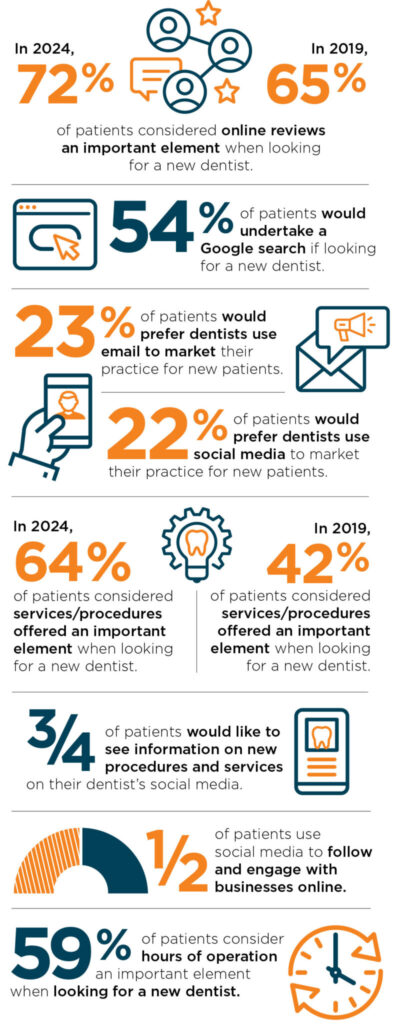
More than half of Canadian patients would take to Google if in need of a new dentist. Once they come across your dental practice during their search, the most important element they consider is the online reviews. However, the list of procedures and services offered has increased in importance over the last five years, especially for certain demographics. For example, for the 60+ age group of survey respondents and the overall response from the province of Quebec, services/procedures ranked just as important as online reviews.
This demonstrates the importance of keeping the most up-to-date information on your website regarding procedures and services. With more complex cases being required, especially by the ageing population, patients are curious to know the extent of what’s offered at your clinic. Be sure to include this information prominently on your website or use social media to reiterate the information to your current patient/follower base.
Your site is not the only thing to keep up to date—you should consider upgrading the skillsets of yourself and your staff. The more services you provide at your practice, the more attractive it can be for patients who don’t want to travel to multiple offices.
As seen in the print issue of Oral Health June 2025
In 2024 Bramm Research, a third-party independent research house, conducted a confidential online survey of general population Canadians who have visited a dentist within the past two years. The survey was limited to those 25 years or older, and nine age brackets were filled proportionally to the Canadian general population. Provincial proportions were also filled to proportionally represent English speakers in Canada of age 25 or higher. The target sample for gender was 50% female and 50% male. The survey launched on Friday, September 20th and closed on Thursday, October 3rd for a total of 14 days in field, and the number of completed responses was 1,000, the same as in 2019. With a total sample of 1,000, the margin of error is plus or minus 3.1 percentage points at the 95 percent confidence level. If, for example, 50% of the sample indicated that agreed with a statement, then we can be reasonably sure (19 times out of 20) of an accuracy within +/- 3.1%. This means that a total census would reveal an answer of not less than 46.9% and not more than 53.1%.
Sponsored by
