


Your dental patients are on social media—but how exactly are they using it? And how can you best leverage your own platforms to reach them?
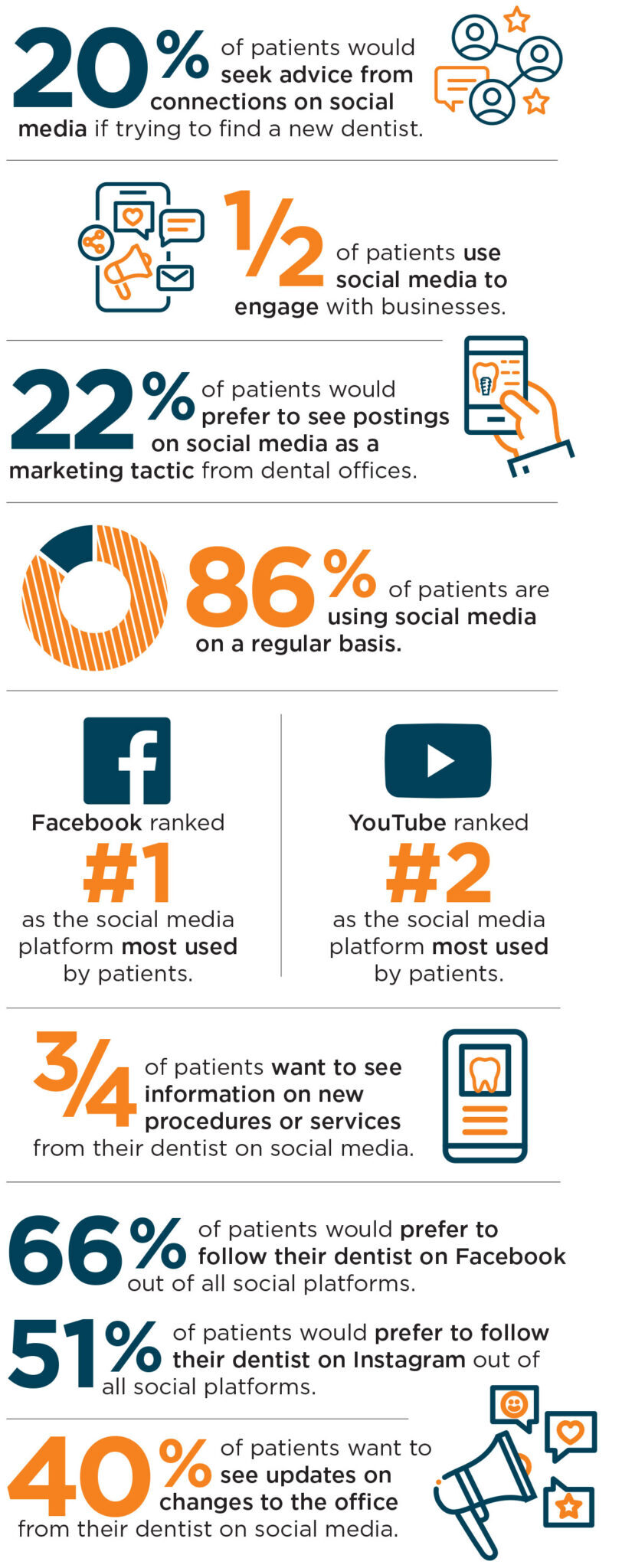
According to our latest survey, half of respondents said they are open to following business accounts, including dental practices. If you are deciding where to focus your efforts, Facebook, YouTube, and Instagram stand out as the top three platforms. Compared with results from five years ago, Facebook has remained the most popular among most age groups (with Instagram leading for those 30 and under). Notably, YouTube has risen to second place, underscoring the growing importance of video content.
When it comes to content preferences, patients are most interested in information about new procedures and services. While fun or lifestyle posts featuring your team can be engaging, patients ultimately value content that supports their oral health and highlights what your practice has to offer. Updates about office changes or staff news are also well received and help foster stronger connections with your team.
How is your office using social media, and what strategies have worked best for you? Share your insights by emailing our Managing Editor at marley@newcom.ca.
As seen in the print issue of Oral Health October 2025
In 2024 Bramm Research, a third-party independent research house, conducted a confidential online survey of general population Canadians who have visited a dentist within the past two years. The survey was limited to those 25 years or older, and nine age brackets were filled proportionally to the Canadian general population. Provincial proportions were also filled to proportionally represent English speakers in Canada of age 25 or higher. The target sample for gender was 50% female and 50% male. The survey launched on Friday, September 20th and closed on Thursday, October 3rd for a total of 14 days in field, and the number of completed responses was 1,000, the same as in 2019. With a total sample of 1,000, the margin of error is plus or minus 3.1 percentage points at the 95 percent confidence level. If, for example, 50% of the sample indicated that agreed with a statement, then we can be reasonably sure (19 times out of 20) of an accuracy within +/- 3.1%. This means that a total census would reveal an answer of not less than 46.9% and not more than 53.1%.
Sponsored by
