
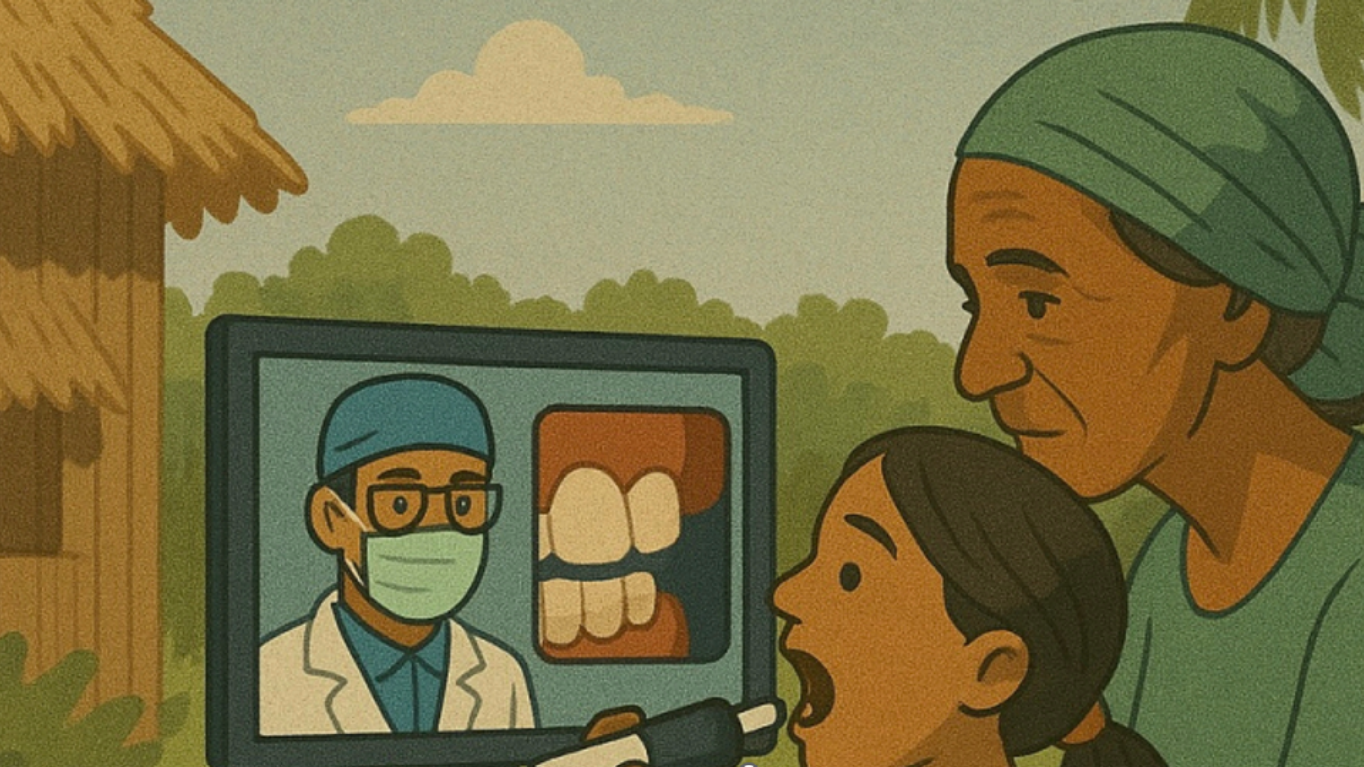
Access to quality dental care remains a significant challenge for populations living in remote areas. Geographic isolation, high costs, and socioeconomic disparities often prevent individuals from receiving timely oral healthcare, leading to severe long-term consequences.
Traditional dentistry struggles to bridge this gap due to limited infrastructure and workforce shortages. However, advancements in Teledentistry, accelerated by the COVID-19 pandemic, have opened new possibilities for remote diagnosis and treatment.
Now, with the integration of more accessible Artificial Intelligence (AI), oral healthcare is on the brink of a revolution, offering affordable, efficient, and accessible solutions to those who need it most. Artificial Intelligence is not a new concept.
Since Alan Turing’s pioneering work in the 1950s, AI has evolved from theoretical models to real-world applications that now impact every industry—including dentistry. Today, AI is reshaping how we approach dental care, particularly in remote and underserved areas.
With AI-driven diagnostics, predictive analytics, and Teledentistry, dental professionals can provide high-quality, accessible, and cost-effective care regardless of a patient’s location. These technologies are already being integrated into imaging analysis, treatment planning, and virtual consultations, offering promising solutions to bridge the gap in oral healthcare access for remote and low-income communities.
AI-Powered diagnostic tools
AI-powered diagnostic tools are revolutionizing remote dentistry by analyzing vast datasets of dental images, X-rays, and patient records.
These advanced technologies can detect oral health issues such as cavities, gum disease, and even early signs of oral cancer with remarkable precision—often identifying problems that human eyes might overlook. For example, Viz.ai uses AI to flag critical conditions such as periodontitis and detect subtle lesions that could be early signs of oral cancer, enabling quicker intervention. Overjet, another powerful AI tool and one of many similar systems, analyzes dental X-rays to automatically detect cavities, assess bone loss, and identify misalignments, providing dentists with comprehensive insights for treatment planning.
Research has shown that AI systems can detect dental caries with up to 94% accuracy, which is comparable to, or even exceeds, the performance of human clinicians (Schwendicke et al., 2020, Journal of Dental Research). AI-based tools also excel in identifying other issues such as root fractures and dental abscesses, often detecting these problems in their earliest stages, allowing for timely intervention. Early detection not only prevents complications but also significantly improves patient outcomes. In regions where access to in-person diagnostics is limited, such as rural or isolated communities, AI tools represent a major breakthrough in preventative care. These technologies enable Teleconsultations, where AI assists dentists in diagnosing and recommending treatments remotely, ensuring that even the most underserved populations receive quality care.
AI-Powered Teledentistry
Teledentistry is rapidly becoming a fundamental aspect of modern dental care, and AI is taking this innovation to new heights.
AI-powered virtual dental assistants gather detailed patient histories, assess symptoms, and even provide initial risk assessments. These intelligent systems streamline consultations, allowing dentists to focus on more complex clinical decisions.
Additionally, AI analyzes patient-submitted images and live video feeds during virtual visits, identifying potential issues and assisting dentists with accurate diagnoses and recommendations. A prime example is the SmileMate platform, which uses AI to support clinicians in virtual dental assessments, improving diagnostic precision and enhancing the patient experience (Dental Monitoring, 2023).
With AI-powered diagnostic tools, consultations can happen instantly, enabling dental professionals to assess symptoms, analyze images, and provide recommendations in real-time— eliminating delays typically seen in traditional appointments.
This rapid response facilitates early detection of conditions such as cavities, gum disease, and even early signs of oral cancer, enabling immediate intervention. By allowing instant decision-making, AI can provide accurate and timely advice remotely. As a result, AI and Teledentistry are reshaping the dental care experience—delivering faster, more responsive services, particularly in underserved communities.
Empowering patients
Smart dental devices and AI-integrated apps are enabling ongoing oral health monitoring. From tracking brushing habits to analyzing hygiene routines, these tools provide real-time feedback and transmit data to dental professionals for remote assessment. The Kolibree toothbrush and Philips Sonicare with AI are examples of devices amongst others, offering personalized feedback based on brushing performance.
Moreover, AIpowered reminders also help patients maintain consistent care routines by alerting them to upcoming appointments, treatments, and daily hygiene tasks. One of AI’s most impactful roles is breaking down geographical barriers.
In regions with few dental professionals, AI-driven platforms enable remote consultations with specialists across the globe. AI-based language translation further enhances accessibility by overcoming communication barriers in multilingual regions.
Additionally, AI chatbots and virtual health assistants provide 24/7 support, answering oral health questions, guiding proper hygiene practices, and offering motivation. By making education more accessible and tailored to each individual, AI encourages better health literacy and proactive patient behavior.
Remote dentistry in Brazil
One example of the power of healthcare innovation in remote areas is the work of SUS (Unified Health System) in Brazil.
As Brazil’s public healthcare system, SUS aims to provide universal, free healthcare to all citizens, including those in its most remote and underserved regions. Given Brazil’s vast geographic size and the socio-economic challenges, SUS has been working to address the disparities in healthcare access, especially in places like the Amazon and Northeast Brazil, where residents often face long travel times and limited medical infrastructure. As part of its ongoing efforts to improve healthcare access, SUS has made significant strides in digitalizing healthcare services.
This includes expanding the use of Teledentistry and AI-powered tools to bring medical expertise to hard-to-reach areas. In addition, supporting these efforts are “e-Saúde” and “eSUS”, initiatives that aim to integrate digital technologies across Brazil’s healthcare system, streamlining the delivery of services and improving care coordination.
By incorporating AI into diagnostics, treatment planning, and patient management, these programs have the potential to create more equitable access to care across the country.
With AI-powered remote consultations and diagnostic tools, SUS is demonstrating how technology can be a vital tool for both healthcare equity and inclusion, making high-quality dental care accessible to populations in Brazil’s most remote regions.
The future of AI in remote dental care
is not just enhancing remote dental care—it’s revolutionizing it. From diagnostics and personalized treatment to patient education and scaling global access, AI is paving the way for a future where top-tier dental care is universally available.
As the technology matures, its integration will become a vital part of improving global oral health outcomes. As technology continues to evolve, the potential for remote consultations will expand, making it possible for dental professionals to reach and treat more patients with greater efficiency. By reducing the need for travel and in-person appointments, AI has the potential to address healthcare disparities, ensuring that quality dental care is accessible to everyone, everywhere.
As AI technology matures, its integration into remote dental care will become a vital component in improving global oral health outcomes. By improving accessibility, reducing costs, enhancing precision, and incentivizing preventive care, AI is leading the way toward a future where oral health is no longer limited by location, resources, or socioeconomic status.
However, to fully realize this potential, effective political implementation is essential. Governments must create policies that promote the integration of AI into healthcare systems, invest in digital infrastructure, and ensure equitable access to these innovations, particularly in underserved areas.Through strategic public-private partnerships and supportive policies, AI can become a key tool in overcoming systemic barriers to care and ensuring that everyone, regardless of their socioeconomic background, has access to high-quality dental services.
About the Author:

Julia Michelin, DDS, is an international dentist and the founder and CEO of Dental AI Technologies, a company dedicated to expanding access to oral healthcare through Artificial Intelligence. With experience in Brazil, Ireland, Australia, and Southeast Asia, she has worked with diverse populations, improving dental care accessibility. Passionate about leveraging AI-driven solutions to revolutionize dentistry, she focuses on bridging gaps in care and reaching underserved communities. Her expertise spans clinical practice, research, education, and technology development, positioning her as a leader at the intersection of healthcare and innovation. She envisions a future where AI enhances global oral health for all with humanized care.