
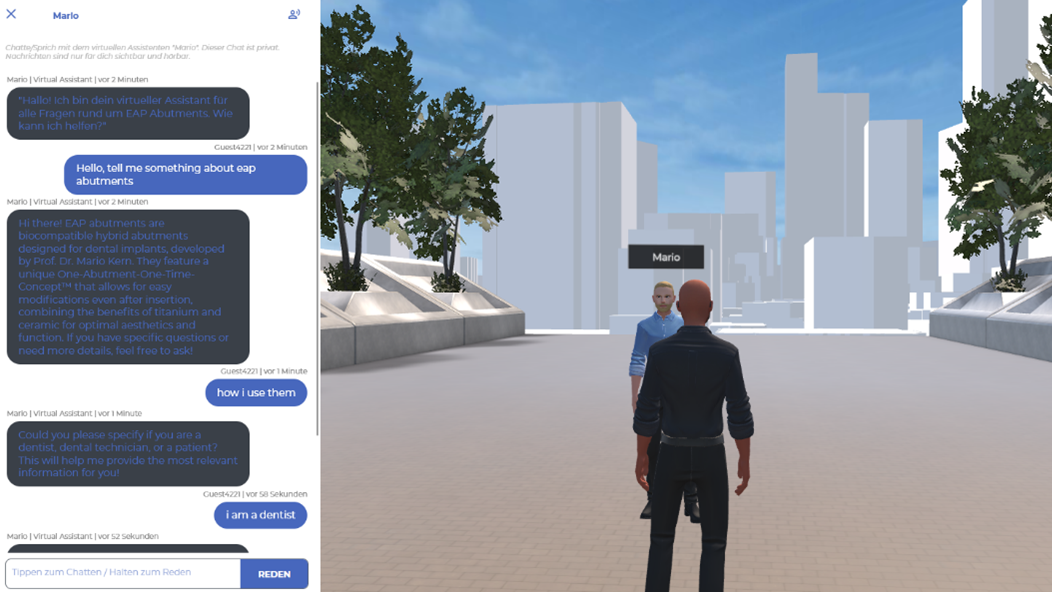
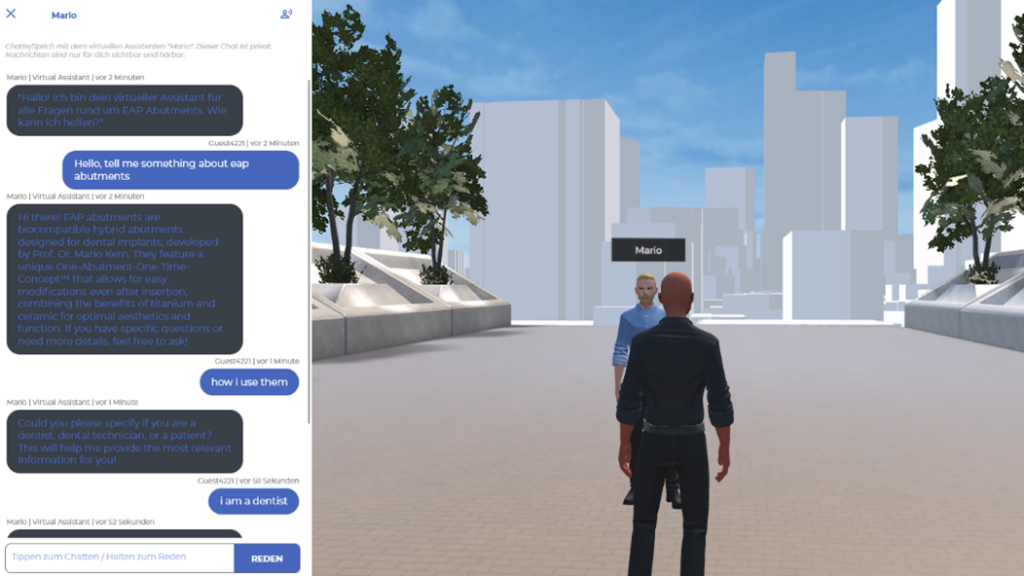
We are at a turning point. Something that can be scary but also offers a lot of opportunities. With the help of artificial intelligence, complex, time-consuming and often monotonous tasks can suddenly be completed very quickly, precisely, and relatively easily. As a small company, we quickly realized that an innovation that turns many things upside down has almost no chance of reaching our customers quickly in direct sales. With the help of our metaverse, we have made a start in informing, entertaining, and educating our customers in a scalable way. The metaverse helps to inform and educate patients in simple and understandable language.
1. General
1.1 Introduction and definition of the metaverse1,2
The concept of the metaverse describes a collective, virtually shared world that is created by merging virtual worlds, augmented realities, and the internet. This vision includes 3D environments that can be shared in real time by an unlimited number of users. These users can interact with each other, communicate, work, play, and perform many other activities that were previously only possible in the physical world. The term “metaverse” was originally popularized in Neal Stephenson’s novel “Snow Crash” (1992), in which he describes a virtual reality that serves as a successor to the Internet.
Figure 1:

1.2 The technical basis of the metaverse3,4
The metaverse is based on various technological innovations and advances. These include:
Virtual reality (VR): Creates a fully immersive digital environment in which users can interact with the virtual world through headsets and other devices.
Augmented reality (AR): Overlays digital information and objects over the real world, merging physical and digital reality.
Blockchain and NFTs: Blockchain technology makes it possible to create, manage, and trade digital assets such as non-fungible tokens (NFTs). These technologies provide the basis for digital economic systems within the metaverse.
5G and cloud computing: Enable low latency and real-time processing of large amounts of data, which is crucial for a fluid experience in a metaverse.
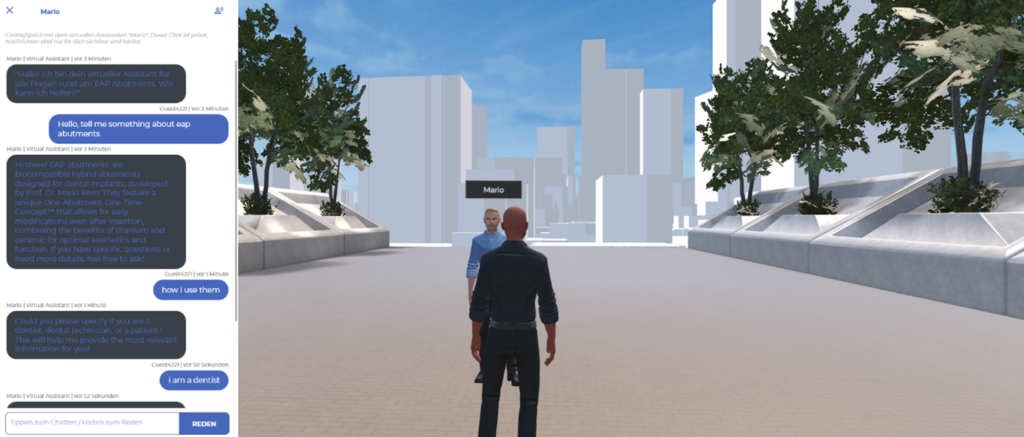
Artificial intelligence (AI): AI helps to create realistic and interactive worlds by controlling NPCs (non-player characters) and processing data for personalized experiences. Real interactive information-based communication can be created with chat-controlled AIs.
Figure 2:
1.3 Areas of application and potential5,6
The metaverse offers a wide range of possible applications:
Education: Virtual classrooms and universities could provide global access to quality education by enabling immersive learning experiences.
Entertainment: Virtual concerts, festivals, and games in metaverses can bring users from all over the world together and create new forms of entertainment.
Economy and trade: Virtual marketplaces and stores where digital and physical goods are traded will flourish in the metaverse. Branded companies are already investing in virtual stores and NFTs.
Social interaction: Social networks could be replaced or supplemented by immersive platforms that enable deeper and more realistic connections.
Working world: Virtual offices and conference rooms could revolutionize traditional working by creating flexible and collaborative working environments.
1.4 Challenges and risks7,8
Although the metaverse offers great opportunities, there are also considerable challenges:
Data protection and security:
In an omnipresent virtual world, data breaches and cyber-attacks could have devastating consequences. Protecting personal data and identities will be a key challenge.
Example: Someone hacks your account, steals your digital identity and your digital assets. How can you take international legal action against this without running into jurisdictional problems with other government organizations?
Regulation and governance: It is unclear how the metaverse should be regulated. As it is a global phenomenon, different national laws and regulations could lead to conflicts.
Example: A global consensus must be found on how to deal with the metaverse and AI in the future. A framework must be established to which countries adhere. Do we need a new international organization like the UN?
Technological hurdles:
The development and deployment of a fully immersive and scalable metaverse platform requires significant technological advances and resources.
Example: We must be aware that the digital world does not leave a CO2-neutral footprint. Everything must become faster and faster and more and more real. Certain hardware parts are being phased out because they are 1.2% slower. Is that socially and environmentally friendly?
Social and psychological effects:
The effects on social interaction and the mental health of users, who may spend a lot of time in virtual worlds, are not yet fully understood.
Example: Screen time could be limited in a similar way to certain online games of chance. Or the use of capital in the virtual world could be limited. What rules are applied? Can the user determine these themselves or are they predetermined?
Data models:
The AI and the processes that are mapped can only be carried out using data models that have already been programmed. The problem here is who entered the data and how the data can be viewed, changed, and kept up to date.
Example: A company uses AI to evaluate the pre-selection of applicants. The data model excludes, for example, diverse or certain sexual orientations. Completely inadmissible and to be rejected outright. But who controls this?
1.5 Economic aspects and market potential9,10
Figure 3:
The metaverse is seen as the next big industry, with potential trillion-dollar markets. Investment in virtual real estate, NFTs, and digital goods is growing rapidly, and companies worldwide are preparing to operate in this new environment. Examples of such investments include virtual real estate in games such as Decentraland and The Sandbox, where properties are selling for millions of dollars.
1.6 The role of large technology companies11,12
Major tech companies such as Facebook (Meta), Microsoft, Google, and Apple are investing heavily in the metaverse. Meta Platforms Inc., formerly Facebook, has publicly committed to its vision of the metaverse and plans to make it the next big platform after the cell phone. These companies are developing hardware, software, and platforms to create the foundation for the metaverse. Competition between these giants could accelerate the development of the metaverse. Smaller innovative companies will be bought up at best or the technology may be lost.
1.7 Future prospects and conclusion13,14
The metaverse is still in its early stages of development, but it has the potential to fundamentally change the way we live, work, and interact. While there is some skepticism and uncertainty about this new technology, the rapid technological advances and corporate interest suggest that the metaverse will play a central role in the coming decades. However, its success will depend heavily on how well the challenges are overcome and whether an open, secure, and accessible platform can be created for all.
2. Benefits of the metaverse for dentistry
The metaverse offers revolutionary possibilities for dentistry that go far beyond conventional practices. Here are the most important areas of application and advantages:
2.1 Virtual training and education
The Metaverse enables immersive, virtual training and simulations that allow dental professionals to practice complex procedures without having to work on a real patient. These virtual environments can include detailed 3D models of human teeth and jaws as well as various dental treatment scenarios. Students and professionals can improve their skills in a risk-free environment.
2.2 Patient education
Dentists can use the metaverse to better inform patients about planned procedures. With the help of VR glasses or AR apps, patients can see a visual representation of their mouth and the planned treatments. This can significantly improve the understanding and acceptance of treatment plans.
2.3 Teledentistry
The metaverse opens new possibilities for teledentistry. Dentists could consult patients in a virtual environment where they can demonstrate and discuss treatments without physically being in the same room. This is particularly useful for patients in remote or underserved areas who would otherwise not have access to specialized dental care.
2.4 Simulation of complex interventions
Before complicated procedures, dentists can run virtual simulations in the Metaverse to plan the best approach. These simulations could also be used for training or for collaboration with colleagues to discuss difficult cases and develop optimal treatment methods.
2.5 Dental laboratory and prosthetics
Dental technicians could use the metaverse to work together on prostheses and implants, regardless of their location. They could check and adjust 3D models in real time, speeding up the manufacturing process and increasing precision.
2.6 Marketing and patient loyalty
The metaverse offers new marketing opportunities for dental practices. Practices could offer virtual tours where potential patients can explore the facility and find out about the services on offer. This could be particularly helpful for practices that use innovative technologies and want to position themselves as progressive.
3. Distribution of a product requiring explanation in the metaverse using the example of EAP® Abutments
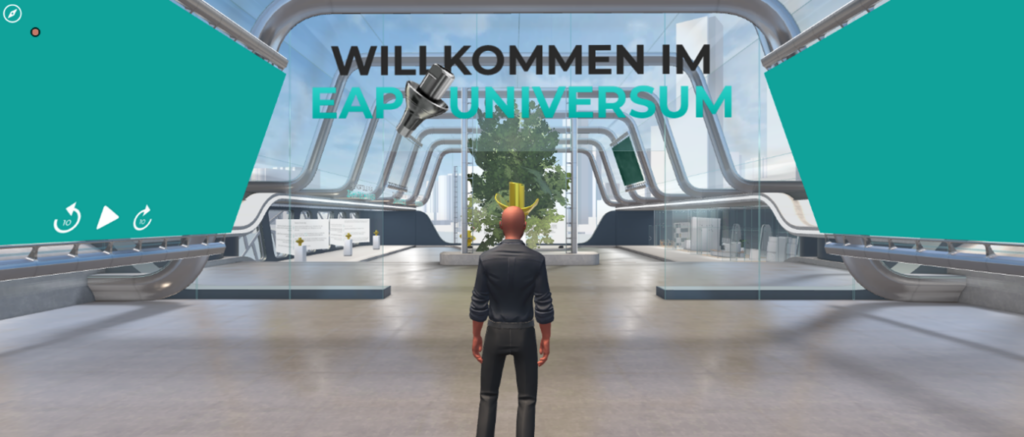
The metaverse of EAP® Abutments is currently still under construction. The technical implementation and the concept are very complex. Converting a previously analog process into a digital process opened our eyes to the fact that even analog processes have the potential to be improved. Converting an immature analog process into a digital process does not mean that it will be better as a digital process. The homework needs to be done even more consistently for the digital processes, as these practically always have “errors” and potential in real time. Like all these processes, these are living processes that are constantly being adapted.
Selling products that require intensive explanation can take on completely new dimensions in the metaverse. Here are some strategies and advantages that this virtual environment offers:
3.1 Virtual showrooms and product demonstrations
In the Metaverse, companies can set up virtual showrooms in which they can present their products in detail. Customers can explore the product in 3D, see how it works, and interactively experience how it is used in practice. This is particularly useful for complex products that are difficult to explain and usually require a demonstration.
3.2 Interactive product advice
Salespeople or product consultants can appear as avatars in the metaverse and interact directly with customers. They can answer questions, explain special features and use VR and AR technologies to demonstrate how the product works in real time. This creates a personalized and intensive consulting experience that is not possible in traditional e-commerce.
3.3 Customer training and webinars
Training is often an important part of the sales process for products that require explanation. In the Metaverse, companies can offer training courses and webinars in a virtual environment where customers can interact directly with the product. These training courses can be delivered as workshops, tutorials, or simulations, greatly reducing the learning curve.
Figure 4:

3.4 Extended reality for the application declaration
With AR, companies can show their customers how the product works in their own environment. Customers could “test” the product before purchasing by seeing how it’s positioned or operates in real-life application scenarios.
3.5 Gamification of the sales experience
By using playful elements (gamification) in sales, companies can increase customer loyalty and make the sales process more entertaining. For example, customers could collect points by trying out various product features in a virtual environment or taking part in virtual challenges that put the product in the spotlight.
3.6 Increasing trust through transparency
The Metaverse offers the opportunity to present products transparently. Companies can present the origin, manufacturing process, and sustainability of their products in detail. This creates trust and can have a positive influence on purchasing decisions, especially for products that require explanation or are expensive.
3.7 Global market access
In the metaverse, companies have access to a global market without the restrictions of physical borders. This is particularly important for products that require explanations, which may have a smaller target group but can be sold worldwide. Virtual trade fairs and exhibitions in the metaverse provide a platform for presenting these products to an international audience.
These approaches show how the metaverse can transform dentistry and the distribution of products in need of explanation by creating immersive, interactive, and personalized experiences that go far beyond traditional methods.
Our considerations for the EAP® Universe are:
- Virtual training and education for dentists and dental technicians15
EAP® Abutments are easy to handle but require a different approach to soft tissue management. This is easy to communicate with the public, but the distribution of information to the masses is cost intensive. Virtual training in the metaverse could train dentists and dental technicians in a way that goes beyond conventional methods. Using 3D models and VR simulations, professionals can practice using EAP® Abutments in a virtual environment before using them in reality. This interactive training could deepen the understanding of proper abutment placement and adaptation, increasing the success rate of implants.
- Extended patient information16
The complex nature of EAP® Abutments often makes it difficult to clearly communicate the necessity and benefits of these components to patients. With the help of augmented reality (AR) and virtual reality (VR), dentists can visually and interactively explain to patients how the abutments work and why they are critical to the long-term success of the implant. For example, patients could see how the abutments work in their own mouths and how they contribute to the stability and aesthetics of the prosthesis. This could significantly increase patient confidence in the treatment and acceptance of the proposed treatment plan.
- Tele dentistry and consultation17
EAP® Abutments could also benefit from the development of teledentistry. Dentists could advise patients in the metaverse without being physically present. These virtual consultations could be particularly helpful in post-implantation care when it comes to checking the function of the abutments and discussing any adjustments. In addition, specialists worldwide could collaborate and discuss complex cases of abutment implantation in virtual conferences to develop the best treatment approaches.
- Product demonstrations and sales support18
The Metaverse offers innovative approaches to product demonstration in the sale of products that require explanation, such as EAP® Abutments. Sales staff could use virtual showrooms to interactively demonstrate the benefits and functions of the abutments to dentists and dental technicians. These virtual experiences could be supplemented by interactive 3D models, simulations of installation processes, and live demonstrations. Another advantage is the possibility of integrating training programs directly into the product demonstrations to ensure that customers understand and can use the abutments correctly.
- Simulations for the optimization of treatment concepts19
Dentists could use the metaverse to plan and simulate complex treatments with EAP® Abutments in advance. This could be particularly useful in cases of difficult anatomical conditions or when customizing abutments. By simulating the treatment in a virtual environment, dentists could determine the optimal placement angle and the correct abutment choice before performing the procedure on the patient. Such simulations would not only increase precision, but also reduce the risk of complications
- Extended reality applications for quality assurance20
EAP® Abutments could be checked in real time during implant placement using augmented reality (AR). Through AR glasses, dentists could see an overlay of the virtual abutment models on the patient’s real jawbone to check the placement and ensure it meets the planned specifications. This technology could also be used to monitor the abutments after implant placement to ensure they are correctly integrated, and no adjustments are needed.
- Global marketing and customer access21
By participating in virtual trade fairs and conferences in the metaverse, the manufacturer of EAP® Abutments could significantly expand its reach. These platforms make it possible to present products to a global audience without being physically present. Manufacturers could offer interactive presentations demonstrating the benefits and technical details of the abutments. In addition, potential customers and partners could test the abutments in virtual scenarios and thus develop a better understanding of their application and benefits.
- Patient retention and aftercare22
For patients who have received EAP® Abutments, the Metaverse could provide a platform to optimize their aftercare. Patients could have access to virtual self-help resources where they could learn how to properly care for their abutments and what to look out for. In addition, they could interact with other patients and professionals in virtual support groups to share experiences and learn about best care practices.
4. Pros & cons
4.1. Advantages of the metaverse:
1. Immersive experiences
The metaverse offers fully immersive environments in which users can “lose” the physical world and immerse themselves in digital worlds. This could be particularly groundbreaking in the entertainment industry, in education and in social interaction. VR and AR make it possible to overcome physical boundaries and explore places or scenarios that are inaccessible in real life.
2. Improved collaboration and productivity
Virtual offices and workspaces can be created in the metaverse, where people can collaborate globally as if they were in the same room. This could revolutionize the way businesses operate as it offers new opportunities for remote working and international collaboration. Meetings and training sessions could be made more interactive and engaging through the 3D environment.
3. New business models and the economy
The metaverse could have its own economy in which digital goods and services are traded. Users could buy, sell, and develop virtual real estate or offer products and services in a digital economy. Crypto currencies and NFTs (non-fungible tokens) play a major role in this, as they enable digital property and transactions to be secure and verifiable.
4. Personalized experience
Users can design their avatars and environments in the metaverse, allowing for a higher degree of personalization. This customization can lead to stronger social connections and an improved sense of community, as each user can create an identity that matches their preferences and interests
5. Education and training
Virtual learning environments can use the potential of VR and AR to make educational content livelier and more interactive. For example, medical students could perform simulations of operations in the metaverse before working on real patients. Technical training, simulations and safe tests in virtual worlds can also significantly enrich the learning process.
4.2. Disadvantages of the metaverse:
1. Dependence on technology and hardware
To fully immerse yourself in the metaverse, you need powerful VR/AR hardware, which is expensive and inaccessible for many people. In addition, the technical infrastructure needed to fully operate the metaverse could be a challenge, especially in countries with limited access to high-speed internet.
2. Data protection and security
The creation of an immersive digital universe gives rise to new data protection and security issues. Data misuse, surveillance, and unauthorized access to personal information could occur, as user data and behavior can be tracked in greater detail. As users interact via avatars, the question also arises as to how anonymity and identity can be protected.
3. Addiction and mental health
One potential risk of the metaverse is an increased dependence on virtual worlds, which could lead people to spend less time in the physical world. This could lead to loneliness, addiction, and other mental health problems. Escaping into virtual worlds could also exacerbate existing social problems, especially for people who find it difficult to socialize in the real world.
4. Economic inequality
As access to powerful hardware and a fast internet connection is required, people on low incomes or in developing countries could be excluded from the benefits of the metaverse. This could further widen the digital divide and lead to a new form of economic inequality.
5. Legal and ethical issues
Regulating the metaverse is a major challenge. Issues of intellectual property, responsibility for content and control over digital goods are currently difficult to resolve. In addition, abuse could occur, for example in the form of harassment, identity theft or fraud, and law enforcement in a global digital space can be problematic.
Conclusion
The metaverse has the potential to revolutionize various aspects of life, from work and education to social life and the economy. However, it brings with it significant challenges, particularly in the areas of data privacy, social justice, and mental health. If these challenges are not properly worked out and regulated, the negative effects of the metaverse could outweigh the positive advances. Another problem is the current lack of a framework for AI itself. These challenges need to be tackled jointly at international level as quickly as possible.
Products that require explanation, especially in dentistry, could benefit considerably from the use of the metaverse and related technologies. The possibilities range from improved training and detailed patient education to innovative sales strategies and optimization of aftercare. The integration of these technologies could not only improve the quality of care, but also increase patient satisfaction and market penetration.
Disclaimer: The author declares that there is no conflict of interest within the meaning of the guidelines of the Journal of Dental Artificial Intelligence Editors. Dr. Mario Kern MSc. MSc. is the inventor and CEO of EAP® Abutments. Pictures © Dr. Mario Kern
References:
- Stephenson, N. (1992). Snow Crash. New York: Bantam Books.
- Dionisio, J. D. N., Burns, W. G., & Gilbert, R. (2013). 3D Virtual Worlds and the Metaverse: Current Status and Future Possibilities. ACM Computing Surveys (CSUR), 45(3), 1-38.
- Lee, L.-H., Braud, T., Zhou, P., Wang, L., Xu, D., Lin, Z., Kumar, A., Bermejo, C., & Hui, P. (2021). All One Needs to Know about Metaverse: A Complete Survey on Technological Singularity, Virtual Ecosystem, and Research Agenda. arXiv preprint.
- Sherman, W. R., & Craig, A. B. (2018). Understanding Virtual Reality: Interface, Application, and Design. Morgan Kaufmann.
- Ball, M. S. (2021). The Metaverse: And How It Will Revolutionize Everything. W. W. Norton & Company.
- Mystakidis, S. (2022). Metaverse. Encyclopedia, 2(1), 486-497.
- Ondrejka, C. (2004). Escaping the Gilded Cage: User Created Content and Building the Metaverse. New York Law School Law Review, 49, 81-101.
- Falchuk, B., Loeb, S., & Neff, R. (2018). The Social Metaverse: Battle for Privacy. IEEE Technology and Society Magazine, 37(2), 52-61.
- Grayscale. (2021). The Metaverse: Web 3.0 Virtual Cloud Economies.
- McKinsey & Company. (2022). Value Creation in the Metaverse.
- Meta Platforms Inc (2021). Building the Metaverse Responsibly.
- Ball, M. (2022). The Metaverse and How It Will Revolutionize Everything. W. W. Norton & Company.
- Evans, J. R., & Schmalensee, R. (2021). Innovation and the Metaverse. Harvard Business Review.
- Kelly, K. (2020). The Inevitable: Understanding the 12 Technological Forces That Will Shape Our Future. Penguin Books.
- Kavanagh, S., Luxton-Reilly, A., Wuensche, B., & Plimmer, B. (2017). A Systematic Review of Virtual Reality in Education. Themes in Science and Technology Education, 10(2), 85-119.
- Gonçalves, R., & Vate-U-Lan, P. (2018). Augmented Reality for Enhanced Patient Education: A Review of Current Literature. International Journal of Educational Technology in Higher Education, 15(1), 1-16.
- Estai, M., Kanagasingam, Y., Mehdizadeh, M., Vignarajan, J., Norman, R., & Tennant, M. (2016). A Scoping Review of the Use of Telehealth in Dentistry. Journal of Telemedicine and Telecare, 22(7), 323-329.
- Javornik, A. (2016). The Mainstreaming of Augmented Reality: A Brief History. Journal of Business Research, 69(11), 5086-5091.
- Alqahtani, N., Alqahtani, M., & Eshky, R. (2018). The Use of Virtual Reality Simulation for Surgical Training in Dentistry. Journal of Oral and Maxillofacial Surgery, 76(12), 2591.e1-2591.e5.
- Moro, C., Štromberga, Z., Raikos, A., & Stirling, A. (2017). The Effectiveness of Virtual and Augmented Reality in Health Sciences and Medical Anatomy. Anatomical Sciences Education, 10(6), 549-559.
- Kaplan, A. M., & Haenlein, M. (2019). The Promises and Perils of the Blockchain Technology for Marketers: Can the Metaverse Live Up to the Hype? Business Horizons, 62(6), 791-801.
- Bhavnani, S. P., Narula, J., & Sengupta, P. P. (2016). Mobile Technology and the Digital Transformation of Healthcare. European Heart Journal, 37(30), 2445-2455.
About the author

Dr. Mario Kern is the Dental AI Association International Ambassador for Austria, World Top 100 Doctor and founder of EAP® Abutments. Expert in digital dental technologies, additive manufacturing and implantology with over 15 years of experience. Multi-patent holder, award-winning innovator, and passionate about dentistry, CAD-CAM, 3D printing, AI and beekeeping.