


Balance billing occurs when dentists charge patients the difference between the Canadian Dental Care Plan’s (CDCP) reimbursement rate and the dentist’s standard fee. Whether to balance bill is entirely at the discretion of the practice owner.
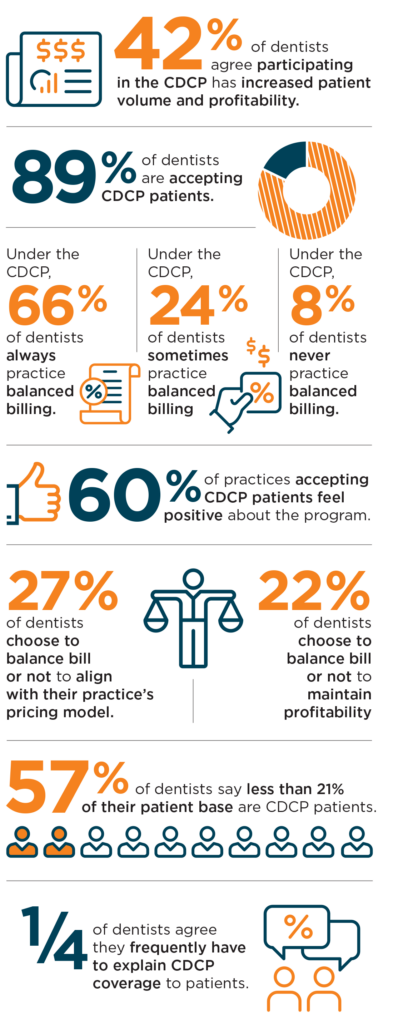
When Oral Health asked readers whether they balance bill, most respondents said they either always or sometimes do. Among those who always balance bill, the primary reasons cited were aligning with their practice’s pricing model (34%), maintaining profitability (27%), and ensuring fair compensation for staff and resources (20%). In contrast, just 8% of Canadian dentists reported that they never use balance billing. Of this group, 58% said their decision was driven by a desire to increase patient access and avoid out-of-pocket costs for patients.
Provincially, British Columbia and the territories reported the highest rate of balance billing, with 93% of dentists indicating they always or sometimes balance bill. Alberta, Manitoba, and Saskatchewan reported the lowest rates, with 44% of dentists saying they always balance bill and 17% saying they never do.
Related article: Can you still profit while accepting CDCP patients?
For practices focused on maintaining or growing revenue, the data is notable: 66% of practices generating more than $3 million in annual revenue report always balance billing, compared to 32% of practices earning less than $500,000 annually.
Ultimately, the decision to balance bill rests with each practice owner. However, for many, it remains one of the most effective strategies for preserving profitability following the introduction of the CDCP. If you would like to share your experience with balance billing, we invite you to contact our Managing Editor at marley@newcom.ca.
As seen in the print issue of Oral Health March 2026
From October 15, 2025 through November 13, 2025 Bramm Research, a third-party independent research house, conducted an online survey of active, practicing, non-hospital affiliated dentists and dental specialists on behalf of Oral Health. Survey invitations went out to a contact list of approximately 9,000 readers and there were 164 completions, for a response rate of 1.8%. With a total sample of 164, the margin of error is plus or minus 7.6 percentage points at the 95 percent confidence level. If, for example, 50% of the sample indicated that agreed with a statement, then we can be reasonably sure (19 times out of 20) of an accuracy within +/- 7.6%. This means that a total census would reveal an answer of not less than 42.4% and not more than 57.6%.
Sponsored by