
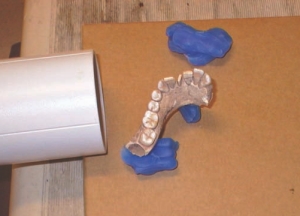
The earliest documented example of osseointegration is a Mayan mandible specimen, nearly 1,500 years old, with three seashells imbedded into the anterior area to replace three incisors. Discovered by archaeologists in 1931 while excavating Mayan sites in Honduras, it was first thought that the seashell implants were placed post-mortem for cosmetic reasons. However, in 1970, Bobbio studied the specimen closely using radiographs and found evidence of osseointegration. 1
With the kind permission of Harvard’s Peabody Museum, in 2000 the author re-examined the specimen and radiographed it again at the Harvard School of Dental Medicine using up-to-date techniques and technology (Figs. 1 & 2).
That pre-Columbian Central American peoples were able to achieve osseointegration without any known understanding of clean surgery, antibiotics, anti-inflammatory agents, anesthetics, surgical instruments and equipment gives pause for thought. Nearly 1,400 years later, or about 100 years ago, the US Patent office issued its first patent for a dental implant to Edwin J. Greenfield of Wichita, Kansas. 2 Inventive dentists produced many implant designs since that time. 3-6 However, none of these endeavours had rigorous science to support them. That remained so until Brnemark, Zarb, Schroeder and others ushered in a new standard for implant investigation in the seventies. 7-9 That is the standard which every new approach in dentistry must meet today.
In illustrating a limited experience with immediate implant placement into debrided pathologic extraction sites, this paper describes the first step of the long process needed to meet the modern research standard.
While placing an alloplast intended for long-term loaded function into a site in which pathology is present seems to be contrary to the first principles of surgery, the idea does rest on ongstanding endodontic experience. Retrograde endodontic treatment consists of surgical debridement or removal of necrotic, damaged or infected tissue at the root apex, most often followed by the insertion of an alloplastic material, commonly silver amalgam, into a prepared
site at the resected root apex. 10 Such treatment improves prospects for healing to such an extent that it has become the standard in clinical dentistry for properly selected cases. A search of PubMed for “retrograde endodontic treatment” produces over 200 papers.
It is but a short step to go from an accepted endodontic technique to the idea of removing a diseased tooth, cleaning out all apical pathology and placing an implant at the same time assuming that adequate stabilization is possible. Such a step, if successful and combined with a one-surgery protocol using one-piece implants, reduces treatment times significantly.
METHOD
Surgical Protocol
— All patients were given a loading dose of 2g of amoxicillin one-hour pre-operatively.
— All patients rinsed with a 0.01% Chlorhexidine Gluconate solution for three minutes, pre-operatively.
— Peri-oral tissues were swabbed with a 4% Chlorhexidine Gluconate solution.
— Benzodiazepine sedation was used when deemed necessary.
— Local anaesthesia was administered using 5% Bupivicaine.
— Each tooth was removed in the usual manner.
— All pathology was curetted out.
— Osteotomy sites were prepared in accordance with the manufacturer’s instructions using high volume suction to aspirate the normal saline irrigating solution.
— Bioactive glass material was packed (PerioGlas® NovaBone Products, Alachua, FL) lightly into all voids and around the one-piece, one-stage implant used for all patients. (The Tenax Dental Implant System ™, Collingwood, ON).
— The mucosa was sutured around the implants using 000 or 0000 chromic gut sutures
– All patients were recalled one to two weeks after the surgery to monitor healing.
Prosthetic Protocol
The prosthetic phase for all patients was completed using individualized, standard technique.
All patients are being monitored at regular re-care appointments on an on-going basis, using clinical examination of the peri-implant soft tissues, radiography, mobility testing and gentle peri-implant probing.
RESULTS
During a period ranging from six to 60 months 13 patients received 16 implants of which two failed. One site was successfully retreated with another, wider implant. The other site was retreated using a conventional three-unit bridge.
DISCUSSION
Advances in implant treatment continue to improve outcomes and simplify treatment. Debriding pathologic extraction sites and placing implants into the area at the same time eliminates one separate step and shortens treatment times by several months. The reduction in the number of treatment steps makes case management increasingly more straightforward. This trend represents a movement towards making implant treatment more accessible to more patients who can benefit from it.
CONCLUSIONS
Immediate implant placement into debrided pathologic extraction sites appears to be practical and should be investigated prospectively in a statistically valid patient population size.
Disclaimer
Tenax implants (Tenax implant Inc. of Collingwood, ON) were used for all cases.
Dr. Somborac Is In Private General Practice And Is A Minor Shareholder In Tenax Implant Inc.
Oral Health welcomes this original article.
REFERENCES
1. A Bobbio, “Maya, the first authentic alloplastic, endosseous dental implant. A refinement of a priority,” Revista Da Associao Paulista De Cirurges Dentistas 27, no. 1: 27-36.
2. United States Patent Office, Patent Number 943,113.
3. R Chercheve “Prostheses fixed by maxillary implants.,” L’ Information Dentaire 37, no. 16 (April 21, 1955): 759-64.
4. G S Dahl, “Superplants. Biomechanical and clinical possibilities,” Die Quintessenz 16, no. 1 (January 1965): 45-51.
5. G Muratori, “Personal Method of Intra-Osseous Implantation Employing a Removable Fixation Rod,” Minerva Stomatologica 14 (February 1965): 95-102.
6. J Scialom, “Implants aiguilles (pin implants),” The Journal of Oral Implant and Transplant Surgery 11 (1965): 18-23.
7. P I Brnemark et al., “Experimental studies on intraosseous anchorage of dental prosthesis,” rsbok. Gteborgs Tandlkare-Sllskap (1970): 9-25.
8. G A Zarb and A Schmitt, “The longitudinal clinical effectiveness of osseointegrated dental implants: the Toronto study. Part I: Surgical results,” The Journal of Prosthetic Dentistry 63, no. 4 (April 1990): 451-7.
9. A Schroeder, O Pohler, and F Sutter, “Tissue reaction to an implant of a titanium hollow cylinder with a titanium surface spray layer,” Schweizerische Monatsschrift Fr Zahnheilkunde = Revue Mensuelle Suisse D’odonto-Stomatologie / SSO 86, no. 7 (July 1976): 713-27.
10. K T King et al., “Longitudinal evaluation of the seal of endodontic retrofillings,” Journal of Endodontics 16, no. 7 (July 1990): 307-10.
———
ABSTRACT
This paper describes a technique for immediate implant placement into debrided pathologic dentoalveolar sockets. MATERIALS AND METHODS: 13 patients had 16 implants placed into debrided pathologic extraction sites. The implants were used to support single tooth and multiple unit fixed prostheses. Preoperative diagnosis of pathology was based on the x-ray presence of periapical lesions alone. The technique focused on scrupulous debridement of the periapical pathology of sockets using curettage of pathologic tissue and socket wall ostectomy using drills under copious irrigation. All voids were grafted using a bioactive glass and all patients received pre-and post-surgical antibiotic coverage. RESULTS: Two implants failed. One site was successfully re-treated w
ith another implant. The other site was re-treated using a conventional three-unit bridge. CONCLUSIONS: Given the advantages of successful immediate implant placement into debrided pathologic extraction sites, the outcome of this limited retrospective review suggests that a comprehensive study is warranted.
———
Such treatment improves prospects for healing to such an extent that it has become the standard in clinical dentistry for properly selected cases
———
Immediate implant placement into debrided pathologic extraction sites appears to be practical and should be investigated prospectively in a statistically valid patient population size