


Our survey shows that most dentists have a pre-determined amount they put toward their marketing budget for the year. But what do the experts recommend?
The Business Development Bank of Canada (BDC) recommends basing your marketing budget on a percentage of your revenue and finds that most B2C small businesses spend between 5 and 10 percent on marketing each year. However, BDC’s 2019 survey reveals that the average marketing spend for businesses with revenue under $2 million a year was around $30,000, representing approximately 1.5 percent for businesses at the higher end of that range.
While every practice has its own unique set of circumstances, let’s look at how you can go about setting up a marketing budget for your practice.
Define Goals and Objectives: Decide what your goals are for the practice, such as how many new patients you would like to acquire each month. The marketing agency DentalScapes recommends calculating your average new patient value and average patient lifetime value (APLV).
Decide on Tactics: Look at how much each marketing tactic is going to cost per month and design a comprehensive plan that incorporates multiple platforms to ensure you are reaching all potential patients.
Track and Adjust: You must determine if your marketing efforts are paying off and which tactics are performing the best. This will allow you to optimize the budget moving forward.
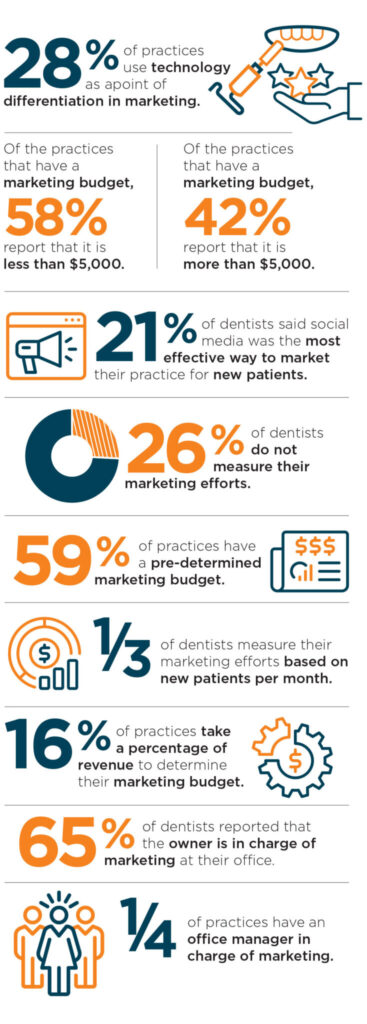
As seen in the print issue of Oral Health October 2024
In October and November 2023 Bramm Research, a third-party independent research house, conducted an online survey of active, practicing non-hospital affiliated dentists and dental specialists on behalf of Oral Health. Survey invitations went out to a contact list of approximately 9,000 readers and there were 265 completions, for a response rate of 2.9 With a total sample of 265, the margin of error is plus or minus 5.9 percentage points at the 95 percent confidence level. If, for example, 50% of the sample indicated that agreed with a statement, then we can be reasonably sure (19 times out of 20) of an accuracy within +/- 5.9%. This means that a total census would reveal an answer of not less than 44.1% and not more than 55.9%.
Sponsored by
