
We don’t know what we don’t know
Society and Community Short-comings
In 1998, Canadian media reported that over 69% of all Children’s Aid Society1 children had been abused. In April 2024, Nova Scotia Justice Minister Brad Johns stepped down from cabinet2 after saying he did not believe domestic violence (DV) is an epidemic, even though the province’s Mass Casualty Commission in 2020 had recommended society treat DV as an epidemic. Later, Ontario’s Queen’s Park enacted the Intimate Partner Violence Epidemic Act in 2024, recognizing that intimate partner violence (IPV) was in fact an epidemic in Ontario and another column stated that governments and the criminal justice system “have a role to play in holding abusers responsible” and that “the system is woefully ill-equipped to address the numerous physical, psychological, social and economic causes and consequences of intimate partner violence.”3
Back in 2019, Canada’s MacLean’s magazine dedicated a major article by Anne Kingston4 on IPV revealing “how systems, politicians and people have failed women and girls,” and recently, the Toronto Star detailed how a 9-year-old girl was sexually abused by her stepfather almost 50 years ago. The article outlined recommendations from Dr. Gabor Maté, a retired family physician from Vancouver’s Downtown East Side. One of the prominent recommendations he made is for investigations to include analysis of the victim’s previous health care providers, including medical, dental, chiropractic, therapists (physio, massage), paramedics, because whatever their multitude of symptoms, most trauma suffers are never asked about it by any health care providers despite research associating childhood adversity with a whole range of adult health problems.”5
Common Procedural Missteps
Few dental teaching institutions provide information on dentistry’s role in recognizing and reporting abuse in spite of the fact that patients/clients (P/Cs) visit dental offices every 4–6 months. Dental health care professionals (DHCPs) should be the first health care professionals (HCPs) to recognize signs and symptoms of traumatic abuse. Instead, abuse continues unrecognized and the epidemic continues.
In 2008, an article from the Royal College of Dental Surgeons of Ontario (RCDSO), “Silence is Deadly: The Dentist’s Role in Domestic Violence Prevention,”6 concluded that bruises are the most common injuries in cases of partner abuse, and the most common location of injury is the head, neck or face. In 2020, Ontario Dentist7 noted domestic violence, child abuse, and human trafficking had reached pandemic levels during COVID and warned that quarantines would result in a “shadow pandemic” with rising abuse cases.
Dentistry often stresses prevention by brushing and flossing, fluoride, x-rays and regular visits. Could prevention also be the answer in reducing IPV? RCDSO’s website8 lists medical history guidelines with basic health questions but none on physical injuries that ask the question about abuse. Medical histories are an easy start, but few health care faculties teach abuse and, consequentially, practising HCPs and DHCPs rarely know what to look for. Why? Because most don’t know what they don’t know. According to the American Society of Forensic Dentistry,9 of all types of abuse (sexual, psychological, emotional, etc.) physical abuse is highest at 35% and most significantly for the DHCP, 65% occurs in the head and neck area (the DHCP’s domain) and 24% on the limbs (arms and legs), making 89% of all physical abuse easily viewable by any HCP – if they know what to look for.
The key to asking medical history questions is to not have guardians in the operatory regardless of the P/C’s age. Guardians are not allowed into hospital emergency or operating rooms. It is inconsistent for DHCPs to allow them into operatories and risk violating P/C’s rights to privacy.
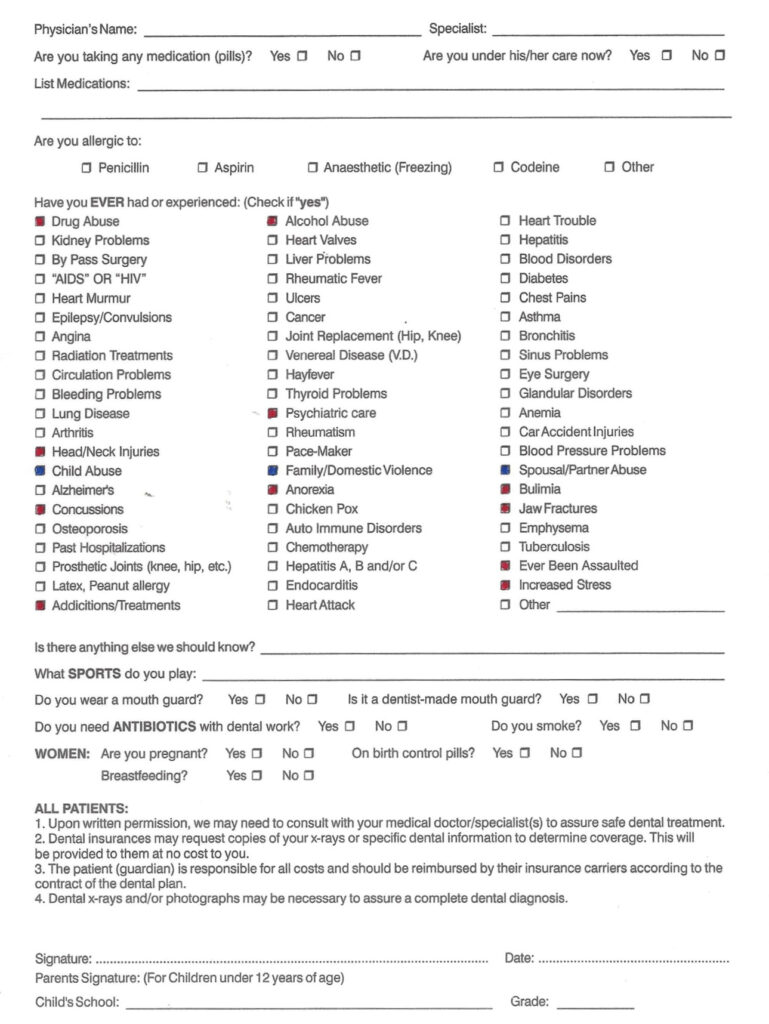
When asked about bruises or cuts, a P/C’s hesitation should have all HCPs suspicious, especially if no response is forthcoming from the P/C or saying, “I can’t remember” or “I don’t know.” A suggested medical history form (Fig. 1) includes medical, social, and recreational questions to be asked of all P/Cs. In my four decades of experience, commonly whenever three or more of the 11 red boxes or just one of the three blue boxes was checked, often an average of 40% of P/Cs had been victims of abuse. It is recommended that all HCPs ask the questions then act because only then will they know what they know.
Fig. 1
Collaborative Care is Needed
DHCPs can often assist abusive and traumatic investigations; however, Canadian national and provincial dental journals, regulators, and association conferences rarely focus on signs and symptoms of mandated abuse recognition or the ethical and legal responsibilities pertaining to all HCP’s Duty to Report. As a result, even suspicions of abuse are seldom reported to the appropriate authorities.
In 2014, the Public Health Agency of Canada Conference on family violence and child abuse prevention noted that “health professionals and front-line workers are well positioned to help prevent violence from occurring or reoccurring in families. However, studies indicate a limited number of HCPs feel comfortable asking about family violence or, in instances when they are treating victims of violence, they do not ask about their safety at home.”10
If all community social and service agencies, HCPs, law enforcement officers, Children’s Aid Society workers, and teachers worked together as a multi-disciplinary team, it is possible more traumatic physical abuse could be stopped in the early stage. So why doesn’t this happen today? The Journal of Dental Education noted HCPs don’t know what to look for and often do not recognize early abuse signs and symptoms. Responsibility also falls with those health care faculties and regulators for not teaching their undergraduates recognition of suspicious patterned injuries, even though multiple studies concluded:
- 87% of domestic violence victims want abuse to be recognized by the dental team and want to receive assistance and/or referrals11
- They want DHCPs to screen for abuse and ask questions about the injuries
- Dental schools should begin to include:
- Didactic information on how to recognize domestic violence
- Instructions on how to conduct a proper interview with detailed recordkeeping
- Instructions on how to provide support once the victim has disclosed the abuse
Journal articles routinely inform DHCPs how to attract new patients and make appointments less stressful; how to provide techniques to better diagnose and treat intra-oral conditions such as caries, pathology, and hygiene; how to evaluate adverse habits related to alcohol, recreational drugs or tobacco, plus how to monitor such conditions. One aspect of IPV confirms – the severity and intensity of abuse escalates with time. A mild verbal comment increases to shouting, a slap becomes a punch, and escalation can result in a homicide.11 Without educating undergraduates and veteran HCPs on the signs and symptoms of abuse, the IPV epidemic continues.
Canadian faculties and regulators can better serve health care by teaching students signs and symptoms to recognize domestic violence and abuse: know what to look for, ask the questions, know where to report their suspicions and provide resources when needed to all P/Cs. Only then can communities begin to effectively reduce the risk of abusive events from reoccurring.
Action with Legislative Backing
If regulated multi-disciplinary HCPs worked as an inter-professional collaborative (IPC) team since they are mandated by Law, the risks to the public would be reduced. Failure to report brings charges of professional misconduct with subsequent fines and/or practice suspensions. However, few HCPs know these mandates exist. The resulting consequences or seriousness of this gap impacts both investigators and victims.
It is recommended that all HCPs read and faculties educate undergraduates on the mandates that they should be aware of, including some of the following:
Child, Youth & Family Services Act (2017) (CYFSA)12
“Reporting Child Abuse and Neglect: It’s Your Duty”:
- Who is a child in need of protection (CINP)?
- Who is responsible to report?
- What are reasonable grounds to report?
- What age is a CINP?
- What is “on-going duty” to report?
- Can someone else report?
- What professions are affected?
- What about P/C privacy?
- Can I be sued if I made a mistake? (No)
- Who are the proper authorities for reporting?
Bill 148 – January 1, 201813
- An employee employed for at least 13 consecutive weeks is entitled to up to 10 days and up to 15 weeks of job-protected leave if the employee or their child experiences domestic or sexual violence or the threat of domestic or sexual violence and the first 5 days of leave will be paid.
- The domestic or sexual violence leave must be taken for one of the following purposes:
– To seek medical attention for a physical, psychological injury or disability caused by the domestic or sexual violence;
– To obtain services from a victim services organization;
– To obtain psychological or other professional counselling;
– To seek legal or law enforcement assistance; or
– Any other prescribed purpose.
Bill C-75 – Intimate Partner Violence (IPV) – November 201914
- a definition of “intimate partner” is added to section 2 of the Criminal Code
- reverse the onus on bail in certain domestic violence cases
- create an escalating sentencing regime for domestic violence offences
- Sections 267 and 272 changes deem:
– Any choking during an assault or sexual assault constitutes a separate offense, whether or not any actual bodily harm was established by the evidence
– Choking is already a form of assault under Section 266
– Where bodily harm is caused, it can be prosecuted under Sections 267 and 272
– Choking will figure prominently in any determination of whether an offense has been made where choking is alleged
Warning Signs / Symptoms for Health Care Professionals (HCPs):
- Bruises on either side of the throat/neck around the “voice box”/larynx
- Bruises can be 4 small round bruises (four fingers) and one larger bruise (thumb) on the opposite side from the four smaller bruises
- Patient/victim has a sore throat, raspy voice, difficulty in swallowing, etc.
Bill C-233 (Federal)15
Bill 102 (Ontario) – August 21, 2023
- Keira’s Law (Bill C-233) was passed and seeks to ensure that judges continue education in matters related to intimate partner violence and coercive control in intimate partner and family relationships. July 17, 2023
- In Ontario, all provincially appointed judges and justices of the peace are now required to be educated and trained in intimate partner violence and coercive control and a progress report will be made annually to the Attorney General
- Bill 102 (Ontario) and C-233 (Federal) brings updates and advancement to the awareness of intimate partner violence
- Result of a private members Bill 102 (Ontario) brought forward by Oakville North-Burlington MPP Effie Triantafilopoulos after the death of 4-year-old Keira Kagan in February 2020.
Recommendations
Practices can conduct “fire drills” to prepare for situations to address P/C’s immediate needs prior to calling 9-1-1. These protocols are mandated by regulators and can be practiced routinely – for medical events – and those of abuse and violence too.
DHCP or P/C financial assistance is available via the Victim Quick Response Program (VQRP)16 when reports are made. Unique codes (90000 series) are also listed in the Ontario Dental Association fee guide.
What is the biggest HCP and practice benefit? Awareness that abused victims will refer others to your practice once they know your dental team knows how to react to abuse. This builds public trust to better serve every community.
References
- Hamilton Spectator, July 8, 1998, “Child abuse cases on rise”
- CBC News, Apr 19, 2024
- Hamilton Spectator, Opinion Page, April 23, 2024.
- MacLean’s, October 2019, “We are the Dead”, Investigation into Intimate Partner Violence
- Toronto Star – July 14, 2024 – Opinion article – “A Familiar Story of Trauma” – Page !N7
- RCDSO, Dispatch Supplement, November/December 2008
- Ontario Dentist, Journal of the Ontario Dental Association, The Shadow Pandemic, April 2020
- https://www.rcdso.org/search-results?q=medical%20history&s
- American Society of Forensic Dentistry, Manual of Forensic Odontology, 5th Edition, CRC Press, 2013
- Canada. Public Health Agency of Canada. Roundtable discussion on family violence and child abuse prevention. Background context. Prepared by the Population Health Promotion and innovation Division, Centre for Health Promotion, PHAC. March 2014
- Journal of Dental Education, Vol. 73, No. 4, April 2009
- CYFSA, https://www.ontario.ca/laws/statute/17c14 (Free)
- https://www.ontario.ca/page/plan-fair-workplaces-and-better-jobs-bill-148
- https://www.justice.gc.ca/eng/rp-pr/csj-sjc/jsp-sjp/c75 p3.html#:~:text=Overview
- OpenParliament https://openparliament.ca › bills › C-233
- Victim Quick Response Program > https://vqrp/ontario.ca
 About the Author

Dr. Frank Stechey, now retired, supplemented his dental practice with sports and forensic dentistry. He has served as team dentist for a variety of junior, professional and national sports teams and is a recognized forensic dentistry Court expert witness and consultant for multi-disciplines in health-care, law enforcement, hospitals, Children’s Aid Societies and long-term care homes throughout Canada and the United States. His practice assisted in both civil and criminal investigations of victim identification, homicides, mass fatality disaster training and response, human trafficking, cases of intimate domestic violence, partner / spousal, family, senior and especially child abuse.