
As discussed last month, we surveyed Canadian dental patients on their preferences and opinions when visiting the dentist’s office. When comparing the data to the survey conducted in 2019, there were a few changes that we wanted to highlight that demonstrate how the patient population is evolving.
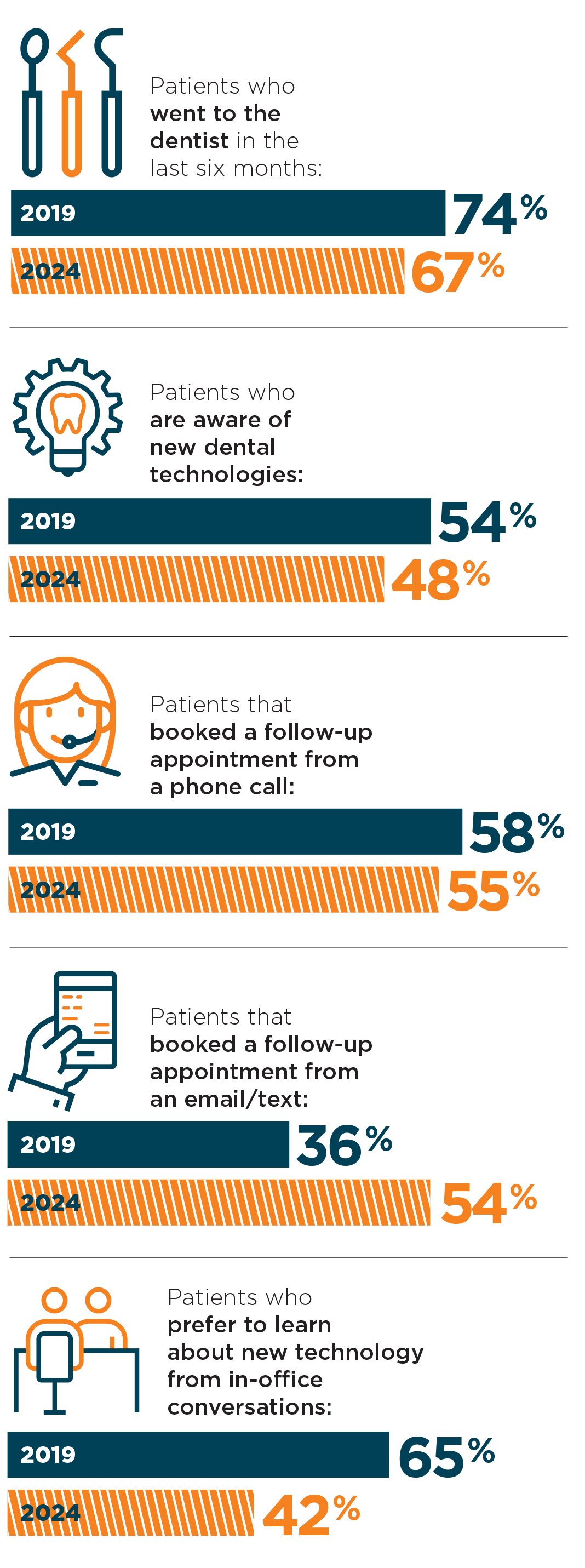
The number of patients attending appointments every 6 months has gone down. In 2019, 74% of patients went to the dentist in the last six months while 67% had gone in 2024. While this is not a huge decrease, it is something to be aware of. Canadian Dental Care Plan patients were more likely to have gone to the dentist in the last six months than patients not participating in the program.
While 54% of patients felt aware of new dental technologies five years ago, only 48% felt aware now. This is a good reminder to keep up your patient education. Patients are more likely to attend appointments and accept treatment if they understand the technology you are using.
Phone calls ranked as the top method to book follow-up appointments in both 2019 and 2024. However, the number of patients that would use email/text to book has jumped from 36% to 54%. This is one of the largest changes in the last five years, and something to consider when following up with patients. Taking into account your patient demographic is also important. For example, for patients aged under 50, email/text follow ups ranked higher than phone calls.
As seen in the print issue of Oral Health February 2025
In 2024 Bramm Research, a third-party independent research house, conducted a confidential online survey of general population Canadians who have visited a dentist within the past two years. The survey was limited to those 25 years or older, and nine age brackets were filled proportionally to the Canadian general population. Provincial proportions were also filled to proportionally represent English speakers in Canada of age 25 or higher. The target sample for gender was 50% female and 50% male. The survey launched on Friday, September 20th and closed on Thursday, October 3rd for a total of 14 days in field, and the number of completed responses was 1,000, the same as in 2019. With a total sample of 1,000, the margin of error is plus or minus 3.1 percentage points at the 95 percent confidence level. If, for example, 50% of the sample indicated that agreed with a statement, then we can be reasonably sure (19 times out of 20) of an accuracy within +/- 3.1%. This means that a total census would reveal an answer of not less than 46.9% and not more than 53.1%.
Sponsored by
