
Wrapping up the final quarter of 2025, several large health-care companies reported strong sales growth.
In late February, medical and dental supplier Henry Schein reported fourth-quarter global sales of US$3.4 billion, up 7.7 per cent year over year — the company’s strongest quarterly sales growth in 15 quarters.
Several other health-care suppliers also reported notable sales growth.
Dental equipment manufacturer Dentsply Sirona posted a 6.2 per cent increase in fourth-quarter net sales, reaching US$961 million.
Medical supply company Medline reported a 14.8 per cent rise in quarterly sales, though net income fell as tariffs and higher operating costs pressured margins.
“We delivered strong fourth-quarter results, concluding a successful 2025 with $2.4 billion in total new customer signings,” said Jim Boyle, chief executive officer of Medline. “This performance reflects the confidence customers place in our value, service and reliability, and our unique capability to support health systems across the entire continuum of care.”
Direct-to-consumer health-care apparel company FIGS Inc. reported 33 per cent year-over-year revenue growth, surpassing US$200 million in quarterly revenue for the first time.
Meanwhile, musculoskeletal device company Globus Medical reported revenue up 25.7 per cent.
Multinational health-care services company Cardinal Health reported fourth-quarter revenue of US$60.2 billion, roughly flat year over year. Excluding the impact of a previously disclosed contract expiration, however, revenue rose about 21 per cent.
Sales surge comes after ADA warning
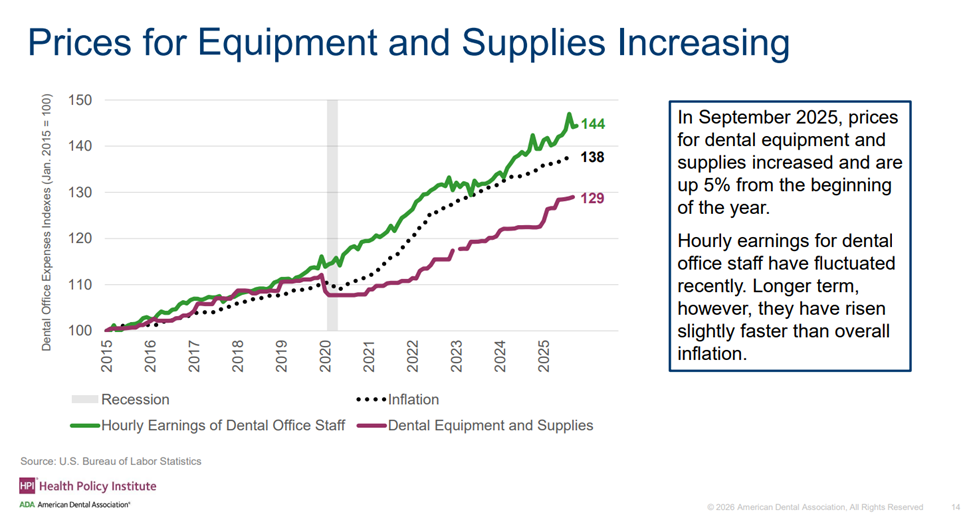
The strong supplier results come as data from the American Dental Association (ADA) suggests U.S. dental practices may be heading into a fiscal squeeze in 2026, driven by rising costs and softer demand for care.
According to the ADA’s Health Policy Institute, about one-third of U.S. dentists reported insufficient patient volume in the fourth quarter.
Related: U.S. dental practices face a fiscal squeeze heading into 2026 — here are the top 10 signals
The mixed signs also highlight a key question facing the dental supply chain: whether the latest revenue surge reflects genuine recovery in clinical demand — or temporary restocking by practices anticipating higher equipment costs.
Michael Dehal, senior portfolio manager at Dehal Investment Partners of Raymond James Ltd., said Henry Schein’s strong quarterly sales growth may partly reflect companies accelerating purchases ahead of potential tariff pressures.
“In the second and third quarters of last year, many companies that import goods, as well as corporate buyers, began building up their inventories,” Dehal said.
“In other words, they purchased equipment and products ahead of time in anticipation that prices might rise in the future.”
That behaviour — often described as front-running demand — can temporarily inflate supplier revenue.
“If you’re worried that equipment components or supplies could get more expensive, you buy now instead of later,” Dehal said. “That can boost quarterly numbers — but it doesn’t necessarily mean long-term demand has permanently increased.”
The dynamic may help explain the apparent disconnect between strong supplier earnings and more cautious signals from dental practices.
Macro pressures building
Broader economic indicators also point to rising price pressures across the health-care sector.
CNBC reported, citing Consumer Price Index data from the U.S. Labor Department, that medical care prices rose 4.2 per cent year over year in August, faster than overall inflation at 2.9 per cent. Physician services increased 3.5 per cent, while hospital and outpatient services rose 5.3 per cent, highlighting rising health-care costs across the sector.
This is occurring against the backdrop of the United States recording a trade deficit of US$70.3 billion in December 2025, according to the U.S. Bureau of Economic Analysis — underscoring uneven economic conditions despite strong supplier earnings in parts of the health-care sector.
Related: Tariffs: Which dental practices are most impacted?
Economic backdrop
In the United States, unemployment is about 4.4 per cent, while real GDP grew at an annual rate of 1.4 per cent in the fourth quarter of 2025, according to the Bureau of Economic Analysis.
The figure represents a slowdown from 4.4 per cent growth in the third quarter of 2025. For the full year, the U.S. economy grew 2.2 per cent.
Those conditions still provide some support for consumer spending — including dental care.
Canada presents a more fragile picture.
Unemployment is closer to 6.5 per cent, while economic growth has been softer and consumer spending remains cautious, according to Statistics Canada.
“We may see more pressure on Canadian practices first,” Dehal said. “The U.S. economy still has stronger household income growth and higher discretionary spending.”
However, Canada’s Canadian Dental Care Plan (CDCP) could act as a partial buffer.
The federal program has expanded access to publicly funded dental services and may help offset demand softness among lower-income patients.
“That government funding is helping backfill some of the pressure,” Dehal said. “It’s supporting patient volume, particularly for basic care.”
Related: CDCP ends 2025 with a milestone — but challenges persist
Still, he cautioned that many practices remain in what he described as a “capital discipline environment.”
“With inflationary pressures, wage growth and economic uncertainty, practice owners are being more selective. Dentists might use their current equipment … get that to last longer,” he said.
If that occurs, supplier growth could moderate in coming quarters — particularly if recent sales gains reflected pulled-forward demand rather than sustained expansion.
For now, the dental sector appears to be balancing two competing forces — strong supplier sales on one side and tightening pressure on practice demand and margins on the other.