Tale of Two Specialties: The Endodontic/Implant Algorithm
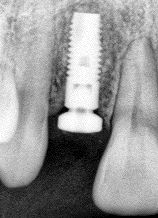
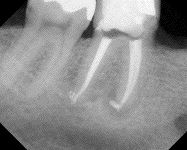
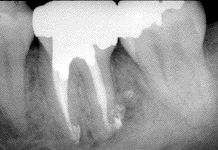
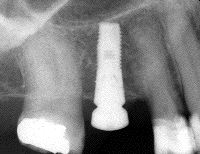
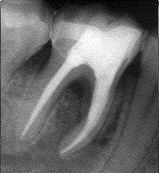
FIGURE 3F--Four months later a fixture and healing abutment were placed. The algorithm sequence followed was logical and sequential; the patient understood her options and chose to retain her natural tooth if at all possible.

Change is a significant evolutionary tool provided it rests upon a solid and secure foundation. Innovations in materials and technologies occurring within the dental field are impacting powerfully on its art and science; however, dentistry, like all health care, is both a business and a profession. The pendulum swings that predicate trends and transitions within … Read more
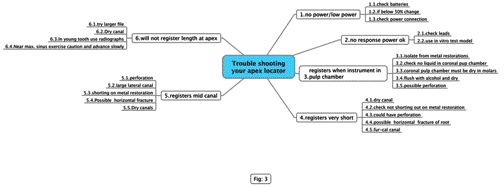
Troubleshooting Your Apex Locator

FIGURE 3

Electronic Apex Locators (EAL) were introduced to the dental profession in the early ’60s by Sunada in 1962 based on the work of Suzuki first described in 1942, where he found that the electrical resistance between a file inserted into a root canal and an electrode attached to the oral mucosa was relatively constant. The … Read more

Bonded Obturation: Time for New Shoes

FIGURE 7--Clinical Case treated with RealSeal and K3 rotary nickel titanium files (SybronEndo, Orange, CA, USA)

In the July, 2004 issue of Oral Health in an article called “Bonded Obturation, A Quantum Leap Forward for Endodontics” Dr. Gary Glassman and I stated, “The surgical operating microscope and the advent of rotary nickel titanium instrumentation have both provided a quantum leap forward towards a higher standard of endodontics. Adhesion has done much … Read more

Misdiagnosis of a Cutaneous Lesion Resulting from a Dentoalveolar Abscess

FIGURE 5--Periapical radiograph demonstrating osseous healing.

Infection, like some diseases, may have many different manifestations. It may surface at the primary site of the source, it may present with atypical signs and symptoms or it may even present at a distant site from its primary source of origin.1 Cutaneous chronic draining sinus tracts can be a manifestation of many diseases such … Read more

A Clear and Present Reality

Dr. Serota is in private endodontic practice in Mississauga, Ontario. He is the founder of the cybercommunities ROOTS (www.rxroots.com) and IMPLANTS (www.rximplants.com). He can be reached at kendo@endosolns.com

The focus on aesthetics has dominated both the dental profession and dental industry for the past decade. Fortunately, the pendulum’s arc has reversed and dentistry is reframing yet again. The profession is revisiting treatment planning, with all its fundamentals and rudiments, from a more functionally integrated perspective. The transition has impacted most upon the specialties, … Read more

Determining TWL from Multiple Sources

Richard Mounce, DDS

In reviewing the literature, I found an article that has important clinical relevance with regard to the determination of TWL and that is worthy of wider discussion (“Frequency of Over instrumentation with an Acceptable Radiographic Working Length” by El Ayouti, et al, JOE, Vol. 27, No.1, January 2001). The purpose of this study was to … Read more

Quick Tips For Creating Better Endodontic Results: 20 Rapid-Fire Ideas

Richard Mounce DDS

1) Carefully study the tooth before beginning treatment. Anticipating clinical challenges and developing strategies is always far preferable to dealing with iatrogenic problems after they occur. 2) Always use a rubber dam, always. If the patient will not tolerate one, the tooth should be extracted. 3) Break treatment into a number of smaller steps, each … Read more

Working Length Determination: Knowing Where to Stop

Richard Mounce

Electronic length determination… is superior to radiographic localization of the apical constriction” from a recent statement of the German Society for Dental, Oral and Maxillary Medicine. I agree wholeheartedly with this statement. Of the various methods of determining true working length (TWL), radiographic measurement of the position of the minor constriction (MC) of the apical … Read more

Prevention Begins with Assessment

Richard Mounce

Recently, I was on a technical scuba diving training dive where a serious accident occurred. The situation was caused by a lack of communication and a faulty dive plan. It was completely preventable. While not potentially fatal, in an endodontic context, the vast majority of problems that bedevil clinicians are also, very fortunately, completely preventable. … Read more

More Effective Endodontics Than Rotary NiTi

FIGURE 10

Regardless of what system is used to shape canals, the goal is to render a canal devoid of as much tissue as possible, producing a shape that can be obturated as close to 100% as possible. Knowing that tissue in canals can be in a variety of invaginations that prevent its physical removal, we also … Read more

How Many Times Can I Use a Rotary Nickel Titanium File?

Rich Mounce

Recently I was asked this question by a reader. The answer is primarily dependent on the brand of rotary nickel titanium (RNT) file used, taper, tip size, how many times it has been used previously and under what conditions. Obviously, clinicians want to obtain the greatest benefit from the given RNT while not having to … Read more

Endodontic Success: Two critical steps

Dr. Mounce

In my opinion, the advent of predictable implant therapy is a good stimulus for endodontics. Implant therapy has, in one view, called on endodontics to improve its predictability, safety and efficiency. If endodontics has a rival in implants, endodontics must meet its competition head on. Observance of two key principles, amongst others, can maximize endodontic … Read more

Bacteria, Bird Droppings, and Bonded Obturation: Clinical Decisions

FIGURE 1--The value with regard to the benefits of bonded obturation cannot be overstated and include for the first time, an obturation that to the greatest extent possible in Endodontics ever, fulfils the three principle functions of a root canal filling listed above. In the empirical opinion of the author, there is no credible evidence in the endodontic literature that RealSeal is not the advance claimed.

The conventional wisdom has traditionally been that, all things being equal, it didn’t matter what was put into root canal systems to obturate them. The old saying “What you take out is more important than what you put in” dominated thinking to a significant degree. Such a statement was often followed up by something along … Read more

One Method to Remove Separated Rotary Nickel Titanium Files

FIGURE 3C

At hands on courses, we are frequently asked how to remove separated rotary nickel titanium files (RNT). It is a skill that has taken years to learn and will continually evolve. Removal of separated rotary files can be addressed from many perspectives, materials science, ultrasonic tip choice, risk of iatrogenic events, clinical technique, etc. Suffice … Read more

A Celebrity Wedding! Hero Joining Sonic

FIGURE 19B

This article provides the clinicians a higher success ratio in endodontic treatment by focusing on advanced mechanical preparation. The protocol of advanced technique is not only increasing quality of prognosis but also the efficiency. Since the introduction of Giromatic (90 degrees reciprocating contra angle) in late ’60s; Techniques and equipment to perform automated root canal … Read more